
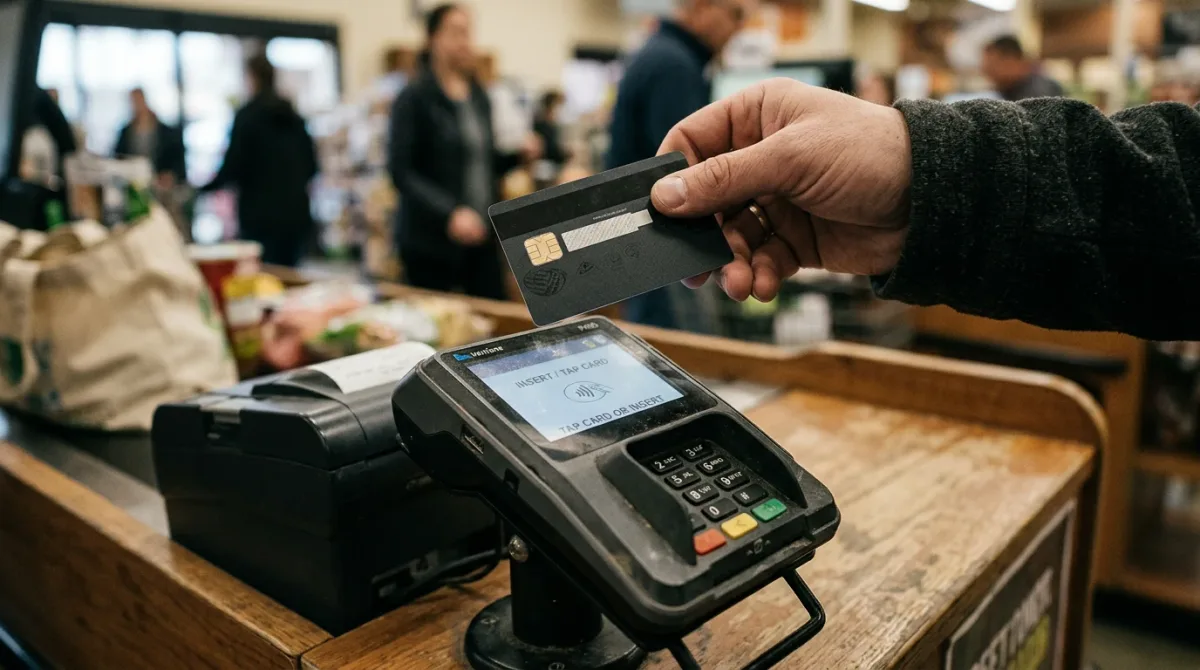
An overdraft happens when your bank pays a transaction that would take your balance below zero, then charges a fee for covering it. Federal rules say banks can't charge that fee on a one-time debit card purchase or ATM withdrawal unless you've agreed to it in advance — say no, and those transactions get declined instead.
What counts as an overdraft, and what triggers the fee?
An overdraft is any transaction your bank pays even though it would push your balance below zero — a debit card swipe, an ATM withdrawal, a check, or an automatic bill payment. The bank fronts the money, then charges an overdraft fee, separate from any interest, for covering the shortfall.
The Consumer Financial Protection Bureau (CFPB), the federal agency that regulates consumer banking, explains that you're required to repay the overdrawn amount plus the fee. There's no single nationwide overdraft fee — each bank or credit union sets its own, and some also charge an extra fee if you don't repay the negative balance within a few days.
Which transactions need your opt-in — and which don't?
Opt-in rules apply only to one-time debit card purchases and ATM withdrawals. Checks and automatic bill payments made through the ACH network can trigger an overdraft fee whether or not you've opted in — there's no opt-out for those.
| Transaction type | Needs your opt-in? | What happens without opt-in |
|---|---|---|
| One-time debit card purchase | Yes | Declined at checkout, no fee |
| ATM withdrawal | Yes | Declined at the machine, no fee |
| Check | No | Can still be paid and trigger a fee |
| Automatic bill payment (ACH) | No | Can still be paid and trigger a fee |
This split exists because checks and automatic payments are treated as commitments you've already made — bouncing them can carry its own consequences, like a returned-payment fee from the biller. Debit card and ATM transactions, by contrast, can simply be stopped at the point of sale if you haven't agreed to pay for the coverage.
How much could an overdraft actually cost you?
The CFPB's overdraft guidance says many banks and credit unions charge $30 or more per overdraft, current as of June 2025, and warns that this figure varies by institution and can change. Some banks also allow more than one fee per day unless they've set a daily maximum.
Here's a hypothetical, built only from that $30 figure: at $30 a transaction with no daily cap, three overdrafts in one day — a coffee, a gas fill-up, and a subscription renewal, say — would add $90 in fees on top of repaying the purchases themselves. Your own bank's fee and any daily limit are spelled out in your account agreement, not here.
What happens if you don't opt in?
Say no to opt-in, and your bank declines a debit card purchase or ATM withdrawal that would overdraw your account — no fee, no completed transaction. Checks and automatic bill payments are unaffected by your opt-in choice either way, since they don't require it.
A 2014 CFPB analysis, described in the agency's own explainer on the opt-in choice, found that accounts opted in to debit and ATM overdraft coverage were three times as likely to rack up more than ten overdrafts a year, and generated roughly seven times more overdraft fee revenue than accounts that stayed opted out. That data is more than a decade old, but the mechanism it describes hasn't changed: a declined transaction costs nothing, and a covered one can cost $30 or more.
How do you check or change your opt-in status?
- Log into online banking or call the number on the back of your debit card and ask about "overdraft" or "opt-in" settings.
- Ask directly whether you're currently opted in to debit card and ATM overdraft coverage — many people don't know their own status.
- Request to opt in or opt out. Banks and credit unions have to let you change your choice at any time, and the change applies going forward, not to past transactions.
- Get written or emailed confirmation of the change, then check your next statement to make sure it took effect.
What alternatives are there to a debit overdraft fee?
A linked savings account can cover a shortfall for a transfer fee that's typically lower than a standard overdraft fee, according to the CFPB. Some banks also offer an overdraft line of credit or credit-card-based coverage, which charges interest and sometimes an activation fee — but for a short-term, small-dollar gap, either option can end up costing less than repeated per-transaction overdraft fees.
None of these choices is right for every situation. What matters is knowing, before you're short on cash, which one your bank actually offers and what it costs.
For a related credit perspective, read How a credit freeze works, and how it differs from a fraud alert.