A government shutdown happens when Congress fails to fund federal agencies before the money runs out, and its financial effects are narrower than the name suggests. Social Security and Medicare payments continue because they are mandatory spending; federal workers stop getting paid but receive back pay by law when the shutdown ends; and financial markets have historically treated even long shutdowns as noise. The record 43-day shutdown that ended in November 2025 followed exactly that script — the real damage landed on delayed paychecks, suspended services, and administrative backlogs that outlasted the standoff itself.
What keeps running — and what stops?
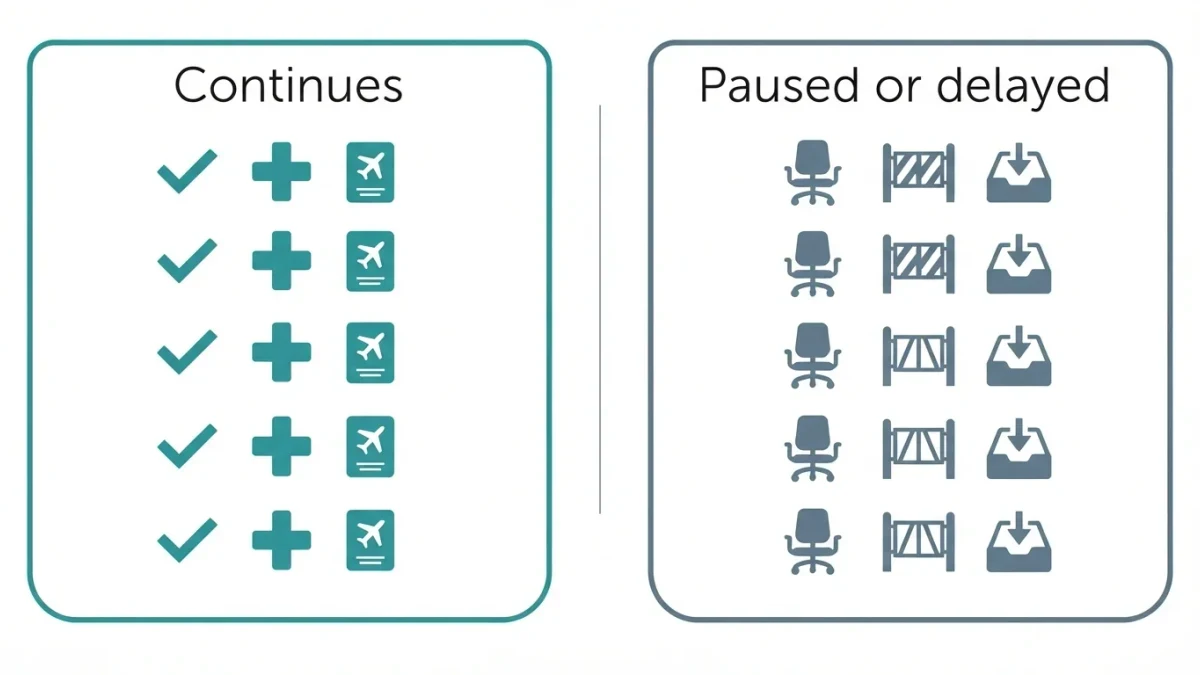
Programs funded outside annual appropriations continue: Social Security checks, Medicare, and federal retirement payments arrive on schedule, though some servicing call centers thin out. Activities funded by user fees and deemed essential — air traffic control, border security, benefit processing deemed necessary — keep staff working. What stops: most discretionary agencies furlough staff, national parks close or run unstaffed, new federal loans and grants stall, and processing that needs a human signature queues up. The queue is the tax most people pay.
| Money question | During a shutdown |
|---|---|
| Social Security check | Arrives on schedule |
| Medicare / Medicaid claims | Continue; new enrollments may slow |
| Federal paychecks | Paused; back pay guaranteed by the 2019 law |
| Tax refunds | E-filing works; processing and help lines slow |
| SNAP / WIC | May face delays or reduced operating windows |
| Mortgage closing needing IRS verification | Can stall until IRS transcript lines reopen |
What should federal employees and contractors do?
Employees get back pay — contractors historically do not, which is the sharpest inequity in every shutdown. Practical moves for anyone with interrupted income: call lenders early — mortgage, auto, and card issuers have hardship programs that suspend or reduce payments during documented furloughs, and asking before a missed payment protects your credit. Trim the budget to essentials immediately rather than draining savings at full spending speed. And treat the interruption as a live drill for the emergency fund: three months of expenses turns a political standoff from a crisis into an inconvenience.
What about benefit recipients who bank on timing?
The check dates hold, so the risk is administrative rather than financial: verification requests, appeals, and new applications queue behind furloughed staff. If you are mid-application for any federal benefit, keep copies of everything you submitted and expect the silence to be a queue, not a rejection. Direct-deposit details unchanged at shutdown start stay unchanged — the payments machinery does not re-route because appropriations lapsed.
What should everyone else do?
Front-load paperwork. Need a passport renewal, an IRS transcript, a small-business loan, or a benefit enrollment? File before funding deadlines loom each fall, because the line only grows once a shutdown starts. Investors should mostly do nothing — over decades, shutdowns have left no lasting mark on long-term returns, and portfolio moves made during political theater tend to be the expensive kind. Savers planning Treasury purchases may see auction hiccups as debt-management staffing thins, but existing holdings are unaffected — the obligations of already-issued Treasuries do not pause.
Does a shutdown hurt the economy?
Measured, yes — lost federal wages, delayed contracts, and reduced spending shave growth for the quarter, and the November 2025 resolution was followed by catch-up spending that restored much of it. But the effect is temporary by construction: the money is delayed, not deleted, apart from contractor losses and park-dependent local businesses. The personal-finance takeaway is preparation rather than prediction: a funded emergency reserve, a lender-relief phone script, and paperwork filed early cover nearly every household exposure.
FAQ
Will my Social Security check be delayed in a shutdown?
No — Social Security is mandatory spending and checks went out on schedule through the record 2025 shutdown. Customer-service wait times can grow as staff thin, but the payment pipeline itself does not pause.
Do federal workers get back pay automatically?
Yes for employees — the Government Employee Fair Treatment Act of 2019 made back pay statutory after any lapse. Contractors paid through expiring agreements have no equivalent guarantee, which is why their exposure is the real financial story of every standoff.
Should I change my investments because of a shutdown?
History argues no — markets have recovered shutdown draws quickly, and long-horizon returns show no permanent shutdown scar. If a shutdown would force you to sell investments for cash, that is an emergency-fund gap to fix, not a portfolio problem.