
What is a recession? It is a prolonged drop in economic activity across a country, not a single bad jobs report or a rough week for stocks. In the United States, a nonprofit research group called the National Bureau of Economic Research (NBER) announces when a recession starts and ends, and it usually does so months after the fact, once the data is clear.
There is a popular rule of thumb that two straight quarters of shrinking GDP — the total value of goods and services the country produces — means recession. Many people use that shortcut. But it is not the official definition, and the official one is broader: NBER looks for a sustained decline across many measures at once, including real income, employment, industrial output, sales, and GDP, according to Fidelity's explainer.
Why does the label matter to you? Mostly because of what happens around it. Hiring slows, incomes get shakier, and borrowing can get more expensive. Knowing what the word actually means helps you read the headlines calmly instead of reacting to every scary forecast.
Who decides that a recession has started?
The National Bureau of Economic Research decides. It is a nonpartisan economic research organization, not a government agency, and it does not follow a fixed formula. Instead, it weighs whether the decline in activity is deep, widespread, and lasting more than a few months.
The data NBER examines includes real income (purchasing power after inflation), employment levels, industrial production, wholesale and retail sales, and GDP, per the Fidelity overview. The committee usually wants those measures falling for more than a few months before it calls a recession, so the announcement often arrives well after the downturn has begun.
There is one famous exception. The 2020 COVID-19 recession lasted only two months, yet NBER still called it one because the collapse was so sudden and severe. That shows the definition is about depth and breadth, not just duration.
What actually happens during a recession?
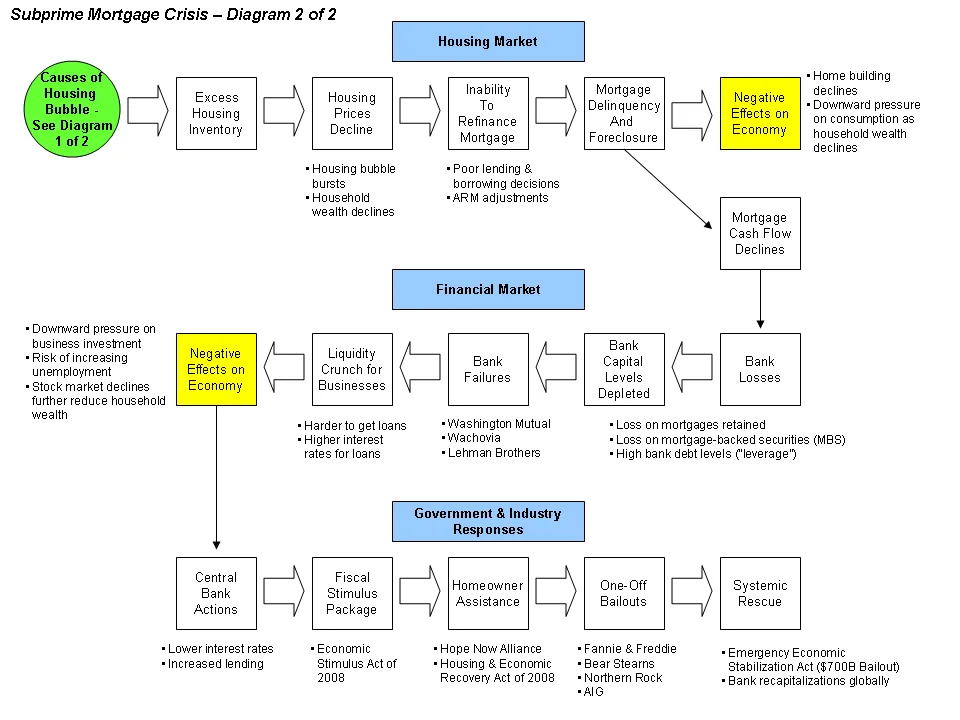
The economy shrinks, and the effects ripple outward. Businesses see lower sales, so they may cut production and lay off workers. Unemployment rises. Company performance and stock results often worsen, and borrowing costs can climb for both households and companies, according to The Economic Times' definition.
The chain reactions matter as much as the first shock. When people worry about their jobs, they spend less. That hurts the businesses they used to support, which can trigger more layoffs, which leaves even less money circulating. In extreme cases, weak demand can even push prices down — the opposite of inflation, called deflation.
Governments usually respond with policies meant to restart growth. Those responses can include lowering interest rates, increasing government spending, cutting taxes, or offering support to struggling industries, per The Economic Times.
What causes recessions?
There is no single cause. Fidelity's overview groups the usual suspects into a few patterns:
- Unexpected shocks. Wars, pandemics, or financial collapses create uncertainty, and companies and households pull back on spending.
- Asset bubbles bursting. When a sector grows faster than is sustainable — as with dot-com-era tech or the 2007–2008 housing market — the bust can spread through the whole economy.
- Overheating. Rapid growth pushes demand past supply, inflation rises, central banks raise interest rates, and borrowing and spending both cool until the economy contracts.
One warning sign that has historically shown up before downturns is an inverted yield curve, when short-term borrowing costs exceed long-term ones. Even so, there is no single reliable predictor of a recession, and economists disagree constantly about timing.
How long do recessions usually last?
Shorter than most people fear, though not predictably. Since 1945, US recessions have occurred on average about once every 6.5 years and lasted an average of 11 months, according to Fidelity. The range is wide: the Great Recession of 2008–2009 ran 18 months, while the 2020 COVID recession lasted just two.
Two more points keep the picture in proportion. Recessions are a normal phase of the economic cycle — growth, peak, recession, trough, and back again — and historically they are much rarer than periods of expansion. The US has also recovered from every recession in its history.
One distinction worth memorizing: a recession is not a bear market. A recession describes the whole economy. A bear market describes stocks falling 20% or more from a peak. The two often overlap, but a bear market does not always cause or even signal a recession.
What does the word mean for your money right now?
Here is the uncomfortable question to ask before acting on any recession headline: who is telling me this, and what can they actually know? Recessions are often recognized only after they have happened, which means anyone claiming to know the exact start date is guessing.
Current forecasts are a good example of that split. According to Business Insider, economist Tuomas Malinen argues the US is close to a downturn, pointing to rising corporate bankruptcies — more than 600,000 filings in the 12 months to June, up 12% from the prior year, per the US Courts office — and a narrowing spread between long-term corporate bond yields and the bank prime rate. But he is in the minority: most Wall Street forecasters expect growth to hold, and Atlanta Fed economists were estimating roughly 4% GDP growth for the third quarter. The same set of data supports both readings.
So what do households typically do when a recession does arrive? The sensible moves are mostly the ones that make sense anyway: keep spending on essentials, avoid taking on new debt while income feels uncertain, and resist panic-selling investments, since selling in a downturn locks in losses that staying invested may have recovered over time. The Economic Times' guidance also flags co-signing loans as riskier in a downturn, because if the main borrower cannot pay, that debt becomes yours.
If you want a deeper dive on the household side, our guide to what a recession actually means for your money covers the practical steps in detail. And if the headlines are getting to you, our piece on how to read financial news without panicking is built for exactly this kind of cycle.
What we know and what we do not
The evidence is clear on the mechanics. A recession is a broad, sustained decline in economic activity, called by NBER after the fact, and typically measured in months rather than years. Recessions have common causes, common government responses, and a long historical average of about 11 months since 1945.
What no one can tell you is when the next one starts or how deep it will be. Forecasts conflict even when they read the same data, as the current split between bearish economists and mainstream growth expectations shows. The most useful takeaway is not a prediction. It is knowing what the word means, so a headline calling one — or denying one — does not push you into a decision you would not otherwise make. For more plain-language coverage of rates, prices, and benefits, browse the rest of our money news section. We covered a connected angle in How interest rates affect your money: a plain-language guide.