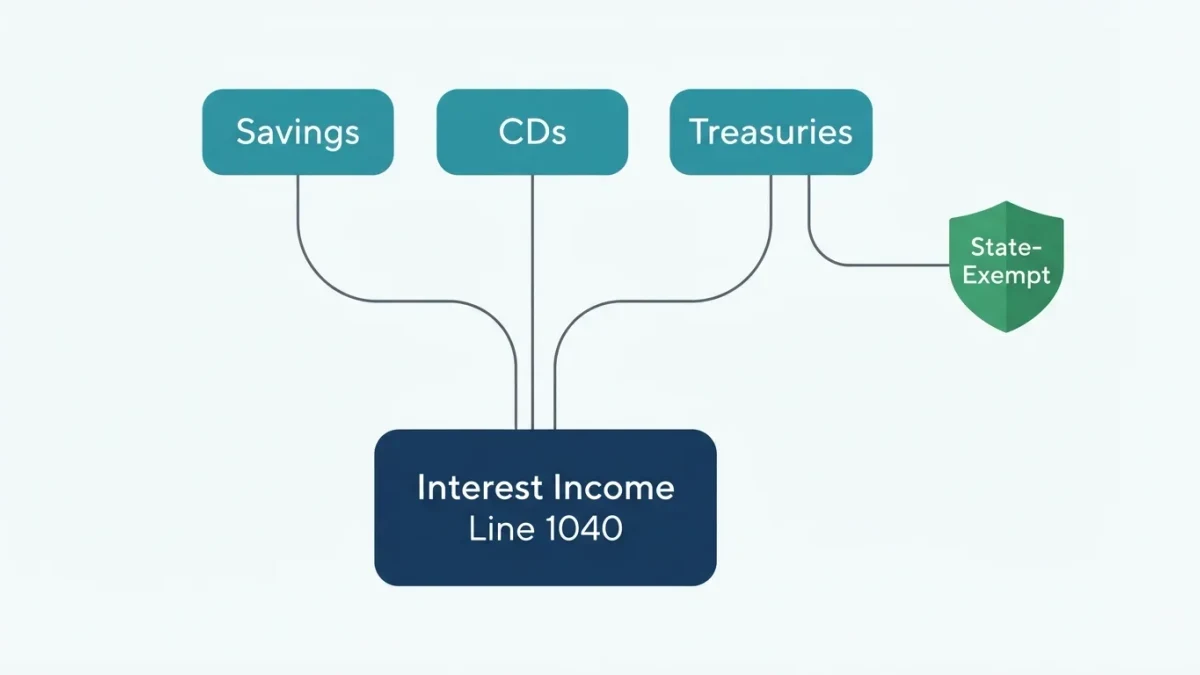
Interest your money earns — savings accounts, CDs, money market accounts, Treasury securities — is taxed as ordinary income in the year it is credited to the account, at the same federal rate as your wages. Once a payer credits $10 or more of interest in a calendar year, it issues Form 1099-INT by January 31 and files a copy with the IRS; below $10 there may be no form, but the taxability does not change — legally, all interest is reportable, form or no form. The saving grace of the current environment is arithmetic: $10,000 earning an assumed 4% APY produces about $400 of interest, which is $400 added to taxable income — real, but modest against the alternative of earning almost nothing.
SAMCASH publishes information, not tax advice — filing outcomes depend on your bracket, state, and overall return, and the IRS instructions control.
How does the 1099-INT actually work?
The bank totals interest credited January through December — credited, not accrued, which is why a CD that pays out at maturity lands its whole interest in the maturity year. Box 1 carries ordinary interest; Box 3 carries Treasury interest including savings bonds; Box 4 shows any federal tax withheld, usually zero unless you asked. The numbers flow to Schedule B if your interest totals exceed $1,500, and to the 1040 either way. Match the payer's name on the form — merged banks report under the new name, and mismatched entries generate automated notices that cost an afternoon.
| Income type | Federal | State |
|---|---|---|
| Bank savings / CD interest | Ordinary | Taxed in most states |
| Treasury bill / note interest | Ordinary | Exempt |
| I bond deferred interest | Deferrable to redemption | Exempt |
| Municipal bond interest | Generally exempt | Often exempt in-state |
What is the state-tax angle?
Most states tax bank interest as ordinary income — a saver in a 5% state bracket keeps about 95 cents of each interest dollar, federally adjusted further. US Treasury interest, including T-bills and I bonds, is exempt from state and local tax by federal statute — which quietly raises the after-tax yield of Treasuries for anyone in a taxed state, as the comparison article math shows: an assumed 4% bill matches a 4.2%-plus bank account for a saver at a 5% state rate. Municipal bonds invert the pattern entirely, exempt federally and usually in-state — the high-bracket saver's instrument, at lower pre-tax yields that reflect the exemption.
Can you reduce the tax on interest?
Legally and modestly, yes — by choosing where the interest is born rather than by hiding it. Shift taxable savings into tax-advantaged wrappers: retirement accounts grow untaxed, and health savings accounts do the same for the medical bucket. Hold taxable bonds and CDs inside IRAs where possible and let taxable accounts hold stock funds, whose qualified dividends and long-term gains rate below ordinary income. Use Treasury products for the state exemption. And for I bonds specifically, the federal tax can be deferred until redemption — decades of compounding before the tax bill, a genuinely useful option for education-timed savings when paired with the education exclusion for eligible households.
What about a CD bought mid-year?
Timing is set by crediting, so a 12-month CD opened in July 2026 pays its interest at July 2027 maturity — all of it lands on the 2027 return. Some CDs credit interest monthly rather than at maturity, splitting the income across years; the account's disclosure states the schedule. Savers timing income around a bracket edge — a year with unusually low other income, say — can use this deliberately: a CD maturing in the lean year carries its interest there.
What if the form is wrong or missing?
Reconcile before filing: total your statements' year-end interest and compare with the 1099-INTs that arrived by late January. Missing form does not mean missing tax — report the bank-statement total regardless. Wrong form: call the payer for a corrected 1099-INT and file with the corrected figure; filing the statement total while the IRS copy says otherwise triggers the automated matching notice. And interest credited in December but shown on January's statement still belongs to December — statements show posting dates, forms show credit years.
FAQ
Do I owe tax if I did not withdraw the interest?
Yes — tax follows crediting, not withdrawal. Interest left to compound in the account was still credited to you and taxed that year, which is why growing balances produce growing 1099-INTs on money you never touched.
Does moving money between banks change the tax?
Only the paperwork — each bank reports its own slice, and multiple 1099-INTs are normal for rate-shoppers. The totals still land on one line of the 1040, and the marginal account that paid $12 of interest still legally belongs there.
Are high yields worth it if they push me into a higher bracket?
Interest is marginal income — only the dollars above a bracket edge price at the higher rate, and those dollars still add to after-tax wealth. Optimize placement (retirement wrappers, Treasuries for state exemption) rather than declining yield.