
Treasury bills — T-bills — are short-term loans to the US federal government, sold in maturities from 4 to 52 weeks with a $100 minimum, per TreasuryDirect. They pay no coupon; instead you buy at a discount and receive full face value at maturity — pay $9,800 today for $10,000 of bills, keep the $200 difference. Two features make them worth a saver's attention: the interest is exempt from state and local income tax, and the backing is the full faith and credit of the US Treasury — the same sovereign promise behind FDIC-insured deposits' ultimate guarantor, one step upstream.
SAMCASH publishes information, not financial advice — whether T-bills fit depends on your state's tax rate, your liquidity needs, and account logistics.
How does the discount actually work?
Through an auction held on a published schedule. Every week the Treasury sells new 4-week and 8-week bills, with 13-, 17-, 26-, and 52-week bills on their own calendars; institutional and retail buyers bid, and the winning yields set the price. A $10,000 26-week bill bought at an assumed 4% annualized discount costs about $9,800 — the exact figure is 10,000 × (1 − 0.04 ÷ 2) = $9,800 — and pays $10,000 at maturity: $200 for half a year's loan. At brokerage you can also buy already-issued bills on the secondary market at any weekday price.
| Maturity | Common use | Liquidity |
|---|---|---|
| 4–8 weeks | Parking cash between decisions | Re-rolls weekly at auction |
| 13–17 weeks | Bill ladder rungs | Matures quarterly |
| 26 weeks | Locking mid-term yields | Matures half-yearly |
| 52 weeks | Longest lock at bill rates | Matures annually |
Where do you buy them?
Two doors. TreasuryDirect, the government's own portal, sells new issues at auction in $100 increments, links to one bank account, and auto-deposits at maturity — the simple route for buy-and-hold. Brokerages offer both new issues and the secondary market, where you can sell early at market price and build ladders across many maturities in one screen. The functional difference shows up when plans change: TreasuryDirect holdings cannot be sold on the market (only transferred between accounts), while brokerage bills sell in seconds — at whatever the market then pays, which is the risk being sold early.
What are the risks, honestly?
Market risk is negligible if held to maturity — the amount received is fixed by the purchase. The two real constraints are reinvestment risk — a 4-week bill reprices at whatever the world pays next month, which cuts both ways when the Fed is moving — and opportunity friction: money inside a T-bill is committed until maturity unless you accept the secondary-market price. Inflation risk remains everywhere: in a 3%-inflation year, an assumed 4% bill clears barely 1% real, before tax. State-tax exemption is the quiet edge: for a saver in a 6% state-tax bracket, an assumed 4% bill's after-tax yield matches a savings account paying about 4.26%.
When do T-bills beat a high-yield savings account?
Three situations. High state taxes — the exemption above is the whole argument, and it scales with the bracket. Rate-locking — when the Fed is cutting, as through the 2025-2026 easing cycle, a 26- or 52-week bill preserves today's yield while a savings APY ratchets down with each FOMC move. And laddering — a rung of bills maturing monthly manufactures scheduled liquidity, the Treasury-flavored version of a CD ladder. Conversely, the plain savings account wins for true emergency money: instant access, no auction calendar, no maturity math at 2 a.m.
How do taxes on the interest work?
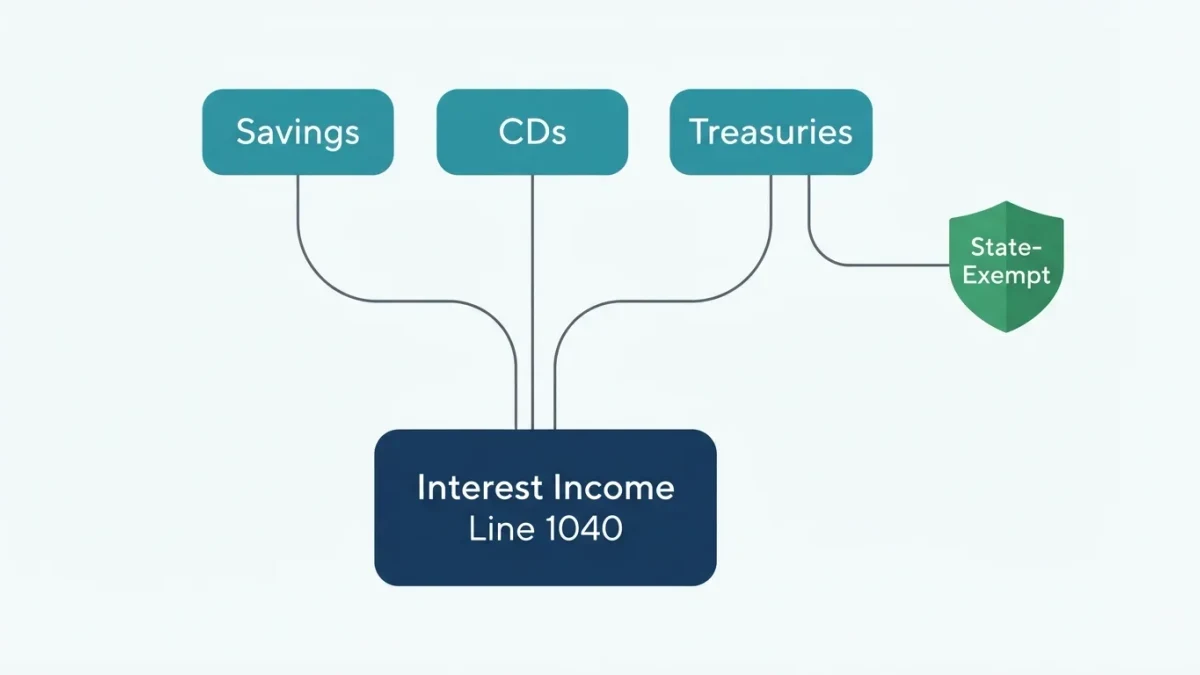
The discount counts as interest income federally — reported on a 1099-INT from TreasuryDirect or the brokerage at $10 or more — and it skips state and local returns entirely. Treasury interest is also exempt from local net investment taxes where those apply, a small compounding kindness in high-tax metros. There is no state tax form to file for it in most states; the federal form carries the documentation.
FAQ
Are T-bills safer than a bank account?
Different issuer, comparable safety for a saver's purposes: bank deposits carry FDIC insurance up to $250,000 per institution, while T-bills carry the Treasury's direct promise — with no cap. Households with balances above insurance limits often hold the excess in bills precisely because the sovereign backing does not run out at a quarter million.
What happens at maturity if I do nothing?
At TreasuryDirect, the face value lands in your linked bank account unless you set up automatic reinvestment into the same term. At a brokerage, cash lands in the sweep and stops earning bill yield — calendar your maturities and re-deploy deliberately.
Can I lose money selling before maturity?
Yes, on the secondary market — if prevailing yields have risen since purchase, an early sale prices your bill at a discount that can exceed the interest accrued. Held to maturity, the payment is fixed; sold early, it marks to market.