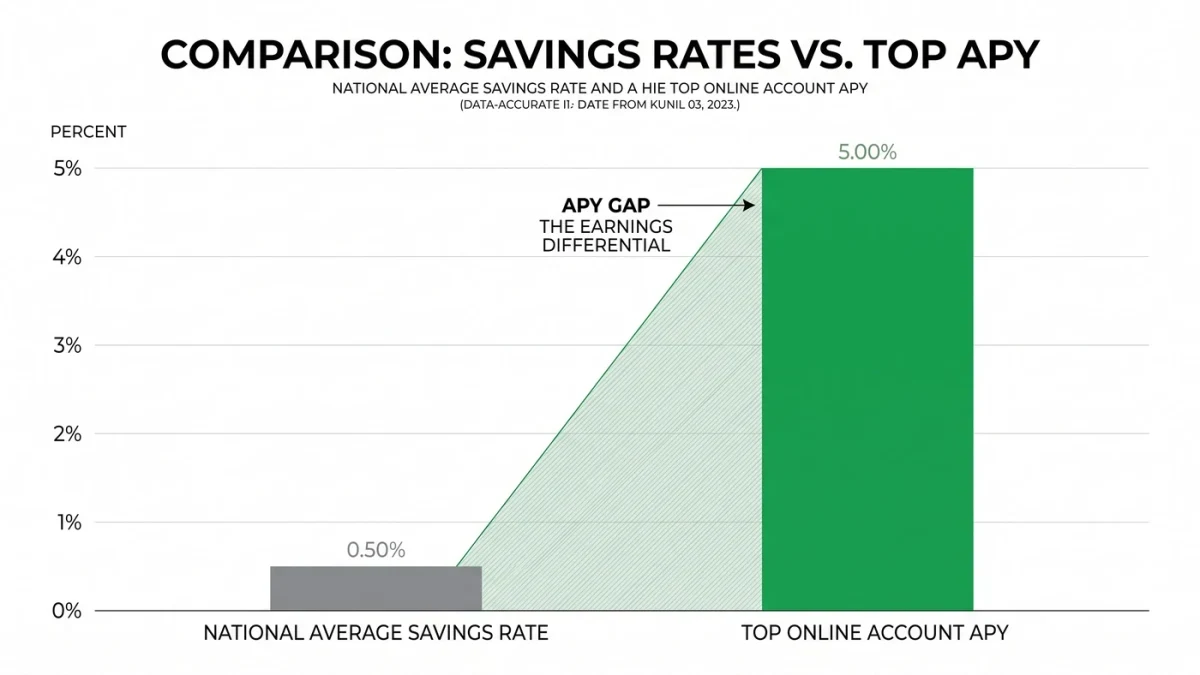

An emergency fund belongs where the full balance is reachable in one to three days, cannot fall in value, and still earns something — which in practice means a high-yield savings account at an FDIC-insured bank paying a competitive APY, with top online accounts around 4% in early 2026 while the national average sat near 0.4%. It does not belong in stocks, because market drops and job losses arrive together, or in a 5-year CD, because penalties defeat the purpose. The one refinement worth making is the two-bucket split: instant access for day-one shocks, and a second, slightly higher-yielding bucket for slow-motion emergencies like a job search.
SAMCASH publishes information, not financial advice — the size and placement of your reserve depends on your income stability and obligations.
Why not just keep it in checking?
Two failures, one obvious and one structural. Obvious: checking pays almost nothing, so a $15,000 fund forfeits roughly $550 a year at prevailing online rates. Structural: money that sits where you spend gets spent — the checking-account emergency fund evaporates into a slightly nicer December, and the emergency arrives to find the shelf bare. Separation is a feature: an account at a different institution, invisible to your daily debit card, is reserve discipline engineered rather than willed.
What makes an account qualify?
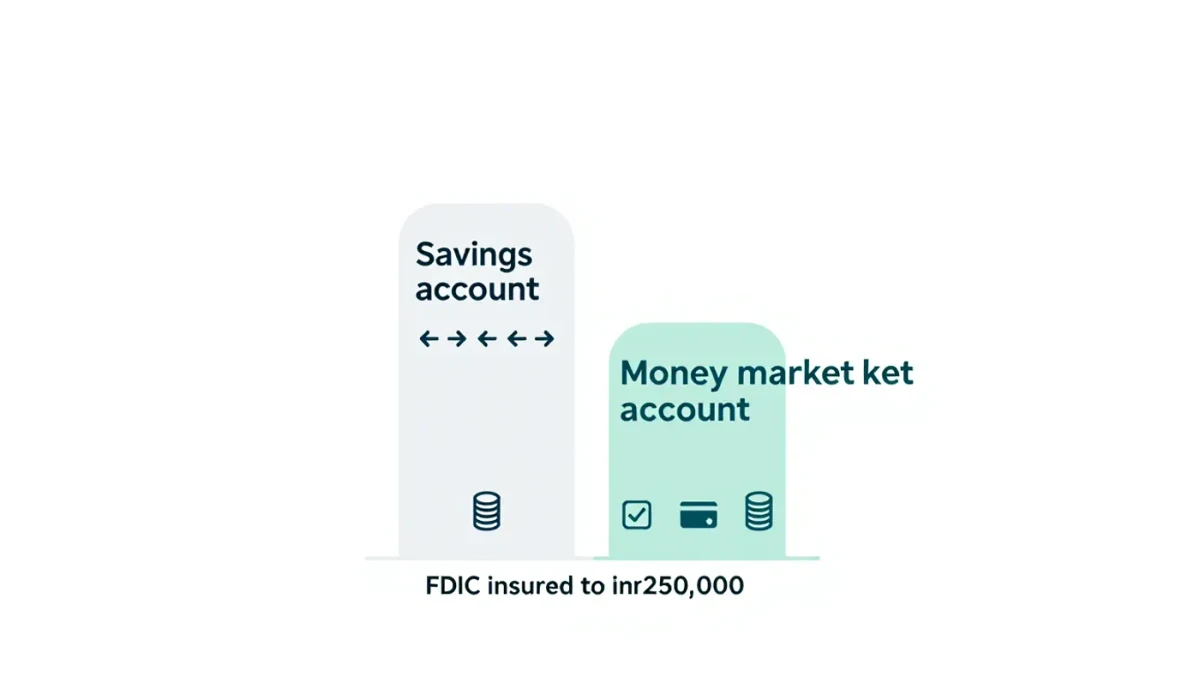
- Federal insurance — FDIC at banks, NCUA at credit unions, to $250,000 per depositor, per institution, per ownership category
- Speed — transfers to your checking bank within one to three business days; same-bank transfers move instantly
- Rate — a competitive APY without promotional expirations or balance games
- No friction — no monthly fee, no minimum that penalizes the balance as you spend it down
What is the two-bucket structure?
Bucket one holds one month of expenses in the high-yield account — fast money for the blown tire and the burst pipe. Bucket two holds months two through six in slightly less liquid, slightly better-paying vehicles: a CD ladder with staggered maturities, or Treasury bills bought in $100 increments at TreasuryDirect, where state-tax-free yields track short rates. A genuine emergency — job loss, medical leave — unfolds over weeks, so a rung maturing within months is liquidity enough for the deep reserve. Keep the split honestly labeled in your own records, because unlabeled bucket two has a way of being spent on a vacation.
| Location | Liquidity | Yield character | Verdict for the fund |
|---|---|---|---|
| High-yield savings | 1–3 days | Competitive, floating | Right home for bucket one |
| CD ladder | Annual rungs | Fixed, contracted | Suits the deep reserve |
| Treasury bills | Weekly maturities | Exempt from state tax | Suits the deep reserve |
| Checking | Instant | Near zero | Too leaky, pays nothing |
| Stock funds | 2 days, volatile | Higher, with drawdowns | Wrong tool — risk pairs with the emergency |
Yield notes reflect early-2026 market conditions and move with Fed policy.
How much should sit in the fund?
The standard guide is three to six months of essential expenses — rent, food, utilities, insurance, minimums — not income. Adjust by volatility: steady dual-income households function near three months; freelancers, commission earners, and single earners in specialized fields justify six or more, because the rebuild takes longer. Start with one month as the first milestone — a mini-fund of even $1,000 measurably reduces the chance a surprise becomes debt — and build from there on automation rather than intention.
When should you spend it — and how do you refill?
The test is needs, not wants: the fund answers to job loss, medical events, urgent home and car repairs, and emergency travel — not to a sale, a wedding season, or a renovation that could have been planned into a sinking fund. After a withdrawal, pause extra investing and direct the freed cash flow back until the target restores. The refill rule matters as much as the fund: households that refill in 90 days keep the system; households that refill someday usually need the fund again first.
FAQ
Should the fund be at the same bank as my checking?
Either structure works with discipline. Same-bank gives instant transfers during the emergency; separate-institution adds friction that protects the balance from casual raids. If leaky spending is your pattern, separation wins — a one-to-three-day transfer is a feature, not a bug.
Are Treasury bills really simple enough for this?
Yes — a TreasuryDirect account buys 4-week to 52-week bills at auction in $100 increments, and maturing money lands back in your linked bank account. The edge over CDs is state-income-tax exemption; the cost is auction scheduling rather than instant purchases.
What if rates fall — should I lock the fund into CDs?
Lock only bucket two, in a ladder, and never the whole fund. After the Fed's December 2025 cut, locking the deep reserve made sense while keeping one month fully liquid; the structure survives rate cycles because its purpose is availability first, yield second.