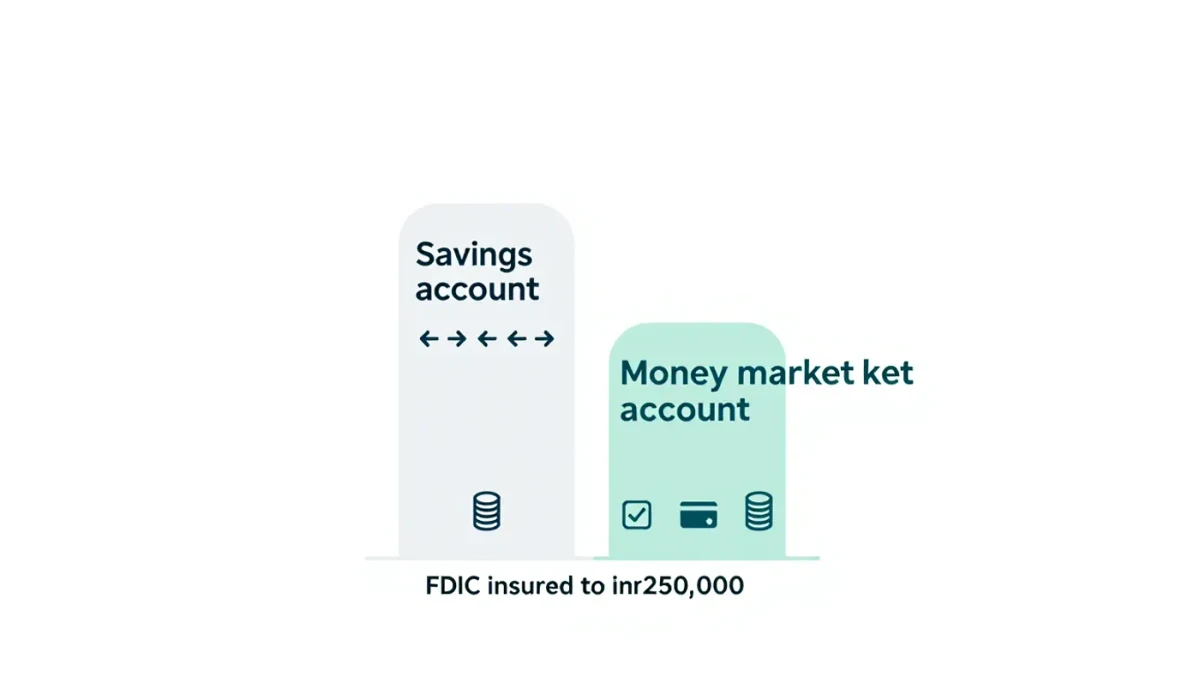
A money market account is a savings account with spending features: at many banks it earns a competitive rate while also offering check-writing privileges and a debit card, usually in exchange for a higher minimum balance. Rates on the two products are similar — both track the Fed's rate moves, and top online versions of each paid roughly 4% APY in early 2026 — so the choice turns on access and minimums, not yield alone. Both are deposit accounts: at FDIC-member banks (or NCUA credit unions) they carry federal insurance up to $250,000 per depositor, per institution, per ownership category.
SAMCASH publishes information, not financial advice — the right account depends on your balance, spending habits, and how often you need to tap the cash.
What are the actual differences?
Three practical ones. Access: money market accounts often include checks and a debit card, while plain savings accounts route money out by transfer. Minimums: money market accounts historically require $1,000 to $10,000 to open or earn the advertised rate, though online banks have eroded this gap from both directions. Rate behavior: both float with the market — neither is a lock, which is what certificates of deposit are for.
| Feature | Savings account | Money market account |
|---|---|---|
| Federal insurance | FDIC / NCUA to $250,000 | FDIC / NCUA to $250,000 |
| Typical access | Transfers only | Checks, debit card, transfers |
| Common minimums | $0 to $100 | $500 to $10,000 |
| Rate at top online banks, early 2026 | ≈ 4% APY | ≈ 4% APY |
| Best for | Emergency fund parking | Large sums you occasionally spend from |
Rate figures are market observations as of early 2026 and change with Fed policy; minimums vary by institution.
Is a money market account the same as a money market fund?
No, and the confusion is expensive. A money market fund is an investment product — a mutual fund that owns short-term Treasury and corporate debt. Its yield is often similar, but it has no federal deposit insurance; in stressed markets its price can dip below $1 a share. If the paperwork says fund or the account lives at a brokerage under an investment agreement, it is not the insured bank product, whatever the similar-sounding name.
Which one fits which job?
An emergency fund belongs in whichever account pays more — access speed comes from linking it to checking, not from the account type, and a one-to-three-day transfer covers most genuine emergencies. A house down payment waiting for closing suits a money market account, where check-writing settles large payments directly. Small irregular goals — annual subscriptions, car registration — work fine in either, parked beside your main savings.
How do you compare offers on either type?
Read four lines in the disclosure box: the APY and its balance tiers, the minimum to earn that APY, the monthly maintenance fee and how to dodge it, and the withdrawal rules the specific bank sets. Then check that the institution is an FDIC member using the BankFind tool at FDIC.gov. Skip promotional teaser rates that step down after 90 days unless you plan to move again that fast — some savers should, and loyalty is not rewarded in this market.
What about credit unions?
The same comparison applies with one label swap: federal credit unions insure deposits up to $250,000 through the NCUA rather than the FDIC, and their money market and savings accounts often price competitively with online banks. Membership rules — usually an employer, geography, or a small one-time donation to a foundation — are the only extra hoop. The disclosure-box reading list does not change.
FAQ
Are money market accounts safe?
As deposit accounts at insured institutions, yes — the same federal insurance as savings accounts applies. The risk to watch is naming, not structure: make sure you opened a bank money market account, not a brokerage money market fund, which is an uninsured investment.
Do both accounts limit withdrawals?
The old federal six-transfers-a-month rule was suspended in 2020, but individual banks still set their own limits or fees. Read your account agreement — the constraint today is bank policy, not law.
Should I split money between both?
Only if each account has a job. A savings account for the emergency reserve plus a money market account for a near-term house fund is a reasonable pair; two accounts holding the same purposeless cash is just two statements to reconcile.