
A sinking fund is money you set aside each month for an expense you already know is coming — car repairs, holiday gifts, insurance premiums, the annual registration renewal. It turns one large, painful bill into a series of small, boring ones. The surprise disappears because the expense was never actually a surprise; only the payment was.
The mechanism is simple. You estimate the yearly cost of a predictable expense, divide it by twelve, and save that slice every month into a separate pot. When the bill arrives, the money is already there. Nothing about your income changed — only the timing of the work the money was always going to do.
The term itself is old finance vocabulary. Dictionaries list a "sinking fund" as a finance term — money accumulated over time to retire a debt or cover a known future cost — and the Collins English-French entry for "sinking" records that exact usage. Households borrowed the idea because it works the same way at any scale.
What is a sinking fund, exactly?
It is a named savings pot with one job. You decide which expense it covers, roughly what that expense will cost, and when it hits. Then you fund it on a schedule. The pot is separate from your emergency fund on purpose: an emergency fund covers what you cannot predict, while a sinking fund covers what you can.
That separation matters more than it sounds. If your car needs new tires and the money came from your emergency fund, your buffer for genuine emergencies just shrank. If it came from a car-maintenance fund, nothing changed. Predictable costs stop raiding the unpredictable ones.
Good candidates for a sinking fund share three traits: you know the expense will happen, you know roughly when, and the cost is big enough to hurt if it lands all at once. Think holidays, property tax bills, annual subscriptions, vet visits, back-to-school shopping, or a down payment you are building toward, which is its own longer project — see how to save for a house down payment.
How do you set one up in five steps?
The setup takes one evening. The arithmetic is the whole method.
- Pick the expense. Choose one predictable cost that has ambushed you before. Start with one or two funds, not ten.
- Estimate the total cost. Look at last year's bill, or the current price, and round up a little for inflation. Your estimate is an estimate — revisit it each cycle.
- Divide by the months you have. A $600 insurance premium due in six months needs $100 a month. A $480 holiday budget spread over twelve months needs $40.
- Give the money its own place. A separate savings account per fund, or labeled sub-accounts if your bank offers them, keeps the money from blending into everyday spending. Where you park it matters for what it earns — a high-yield savings account is one option worth understanding.
- Automate the transfer. Fund it the same day you get paid, alongside any other automatic savings you can actually forget about. Manual transfers work, but they rely on you remembering twelve times a year.
One honest note on the arithmetic: the monthly slices above assume your estimate is right and the expense stays fixed. Prices move. Build a small cushion into the estimate rather than trusting the first number you find.
Sinking fund vs. emergency fund: which pot pays for what?
This is the question that trips people up, so here is the split plainly.
| Question | Sinking fund | Emergency fund |
|---|---|---|
| Did you see it coming? | Yes — you named it months ago | No — it arrives unannounced |
| Typical examples | Car registration, holidays, annual premiums | Job loss, urgent medical bills, a genuine surprise repair |
| Refills how? | On schedule, every month | After any withdrawal, as fast as your budget allows |
| Emotional job | Removes the shock of a known bill | Covers the genuinely unknown |
The boundary test: if you could have written this expense on a calendar, it belongs in a sinking fund. If it could not have been predicted, it is what the emergency fund is for. Both pots matter, and building the emergency one on a tight budget is its own project — see how to build an emergency fund on a tight budget.
Where should the money sit while it waits?
Sinking funds are short-term money. The expense has a date, so the cash needs to be there when the date arrives. That rules out anything with a lockup or a real chance of loss. What you want is a safe, liquid account — one you can pull from the week the bill is due.
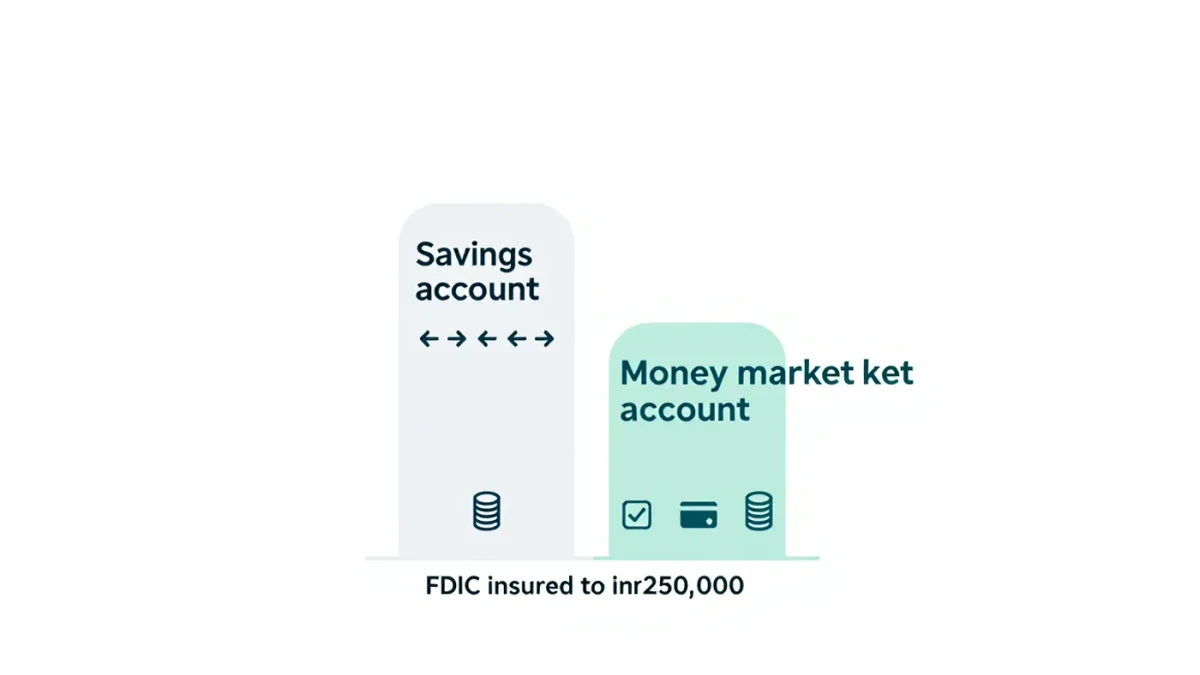
Options differ mainly in access and yield. A standard savings account is simplest. A money market account can be a reasonable alternative if you want check-writing access. Certificates of deposit generally fit only when the fund's deadline is firm and matches the CD's term — the trade-offs of locking money in are covered in what a CD is, and when to use one.
Interest earned on any of these is taxable income, which is worth knowing before you compare rates — the mechanics are in how savings interest is taxed.
What this means for your budget
Our analysis of the mechanism is that its real value is not the dollars — it is the removal of volatility from your month. A budget that survives December and tax season is a budget you keep. When a known bill arrives and the money is simply there, you do not reach for a credit card, and you do not restart the debt conversation you thought you had finished.
Start small. One fund for the expense that most reliably wrecks your month. Name it, slice it, automate it. Once the first one runs a full cycle without drama, add the next. The point is not a perfect system on day one; it is a system that makes the predictable boring.
The takeaway
A sinking fund converts a large, scheduled expense into a small monthly line item, using arithmetic you can do on a napkin: total cost divided by months until the bill. It protects your emergency fund for what it is actually for, and it removes the last legitimate "surprise" from a budget you control. What remains unknown is only the exact size of each future bill — which is why every estimate should carry a cushion and a review date.