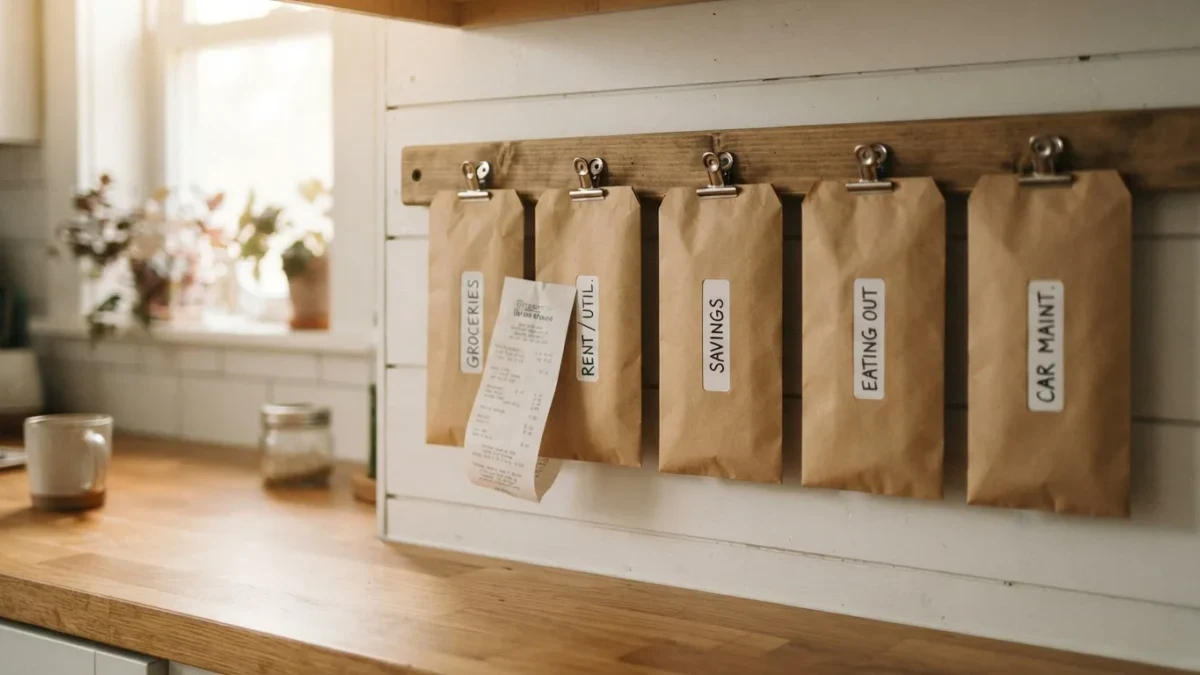
Envelope budgeting divides your money into labeled envelopes at the start of the month — groceries, gas, dining — and enforces one rule: when an envelope is empty, spending in that category stops until the next fill. The physical version worked for generations because cash makes limits visceral; the digital version replaces the paper with app categories that visibly drain as your card posts transactions. What survives the translation is the part that matters — a per-category ceiling you can see falling — and what improves is everything around it: no ATM runs, automatic transaction capture, and rollover that a paper envelope couldn't do.
How does the digital version work?
You fund virtual envelopes on payday and assign each card transaction to one. When the grocery envelope shows $47 remaining, that number is doing the same job as three twenties and a five in a paper sleeve. Most dedicated envelope apps also carry underspent balances forward automatically, which fixes the paper system's month-end problem — unspent cash loitering in drawers instead of compounding in savings.
Who is envelope budgeting for?
People whose leaks are specific and visible. If every month ends with surprise restaurant totals or grocery creep, an envelope hard-stops exactly those categories while fixed bills run on autopay outside the system. It is weaker for households whose problem is income shortfall rather than category creep — no envelope structure fills a gap between earnings and needs — and heavier than a ratio budget like 50/30/20 for people who don't need per-category guardrails.
What does a month look like?
On $3,200 of take-home pay, fixed bills — rent $1,150, utilities $180, insurance $145, phone $85 — can stay on autopay ($1,560 total). The envelope layer handles the flex categories: groceries $480, gas and transport $260, dining $220, household and personal $180, entertainment $140, and a buffer envelope $100. That leaves $260 flowing straight to savings before envelopes are even filled. Table:
| Envelope | Monthly fill | Runs on |
|---|---|---|
| Groceries | $480 | Cash or app |
| Gas & transport | $260 | App or cash |
| Dining out | $220 | Cash |
| Household & personal | $180 | App |
| Entertainment | $140 | App |
| Buffer | $100 | App, rolls over |
Illustrative fills — the amounts are yours to set; the ceiling is the method.
Which categories should actually be cash?
The ones you chronically blow through. Physical cash outperforms digital guardrails for exactly two reasons: handing over twenties registers as spending in a way a tap does not, and an empty envelope is a hard stop with no overdraft. A workable hybrid: cash for dining and one leak category, digital envelopes for the rest, autopay for everything fixed. Going all-cash to make a point usually collapses within a month; a hybrid built around your specific leak survives, and it leaves your cards and credit history running normally in the background.
How do you set it up?
- Pull three months of statements and total your real category spending — the envelope amounts must come from evidence, not aspiration.
- Set each fill at or slightly below the real average; an aspirational 30% cut guarantees failure in week two.
- Choose your tool: an envelope app, a spreadsheet with running balances, or paper and cash for the leak categories.
- Fill on payday, not on the first of the month, so the rhythm matches your income.
- Hold a two-minute weekly glance at remaining balances; mid-month, move money between envelopes deliberately instead of abandoning one.
Where does it fail?
Four honest ways. Envelope inflation — quietly refilling a category mid-month without pulling from another — dissolves the ceiling. Shared spending without shared visibility: a partner spending from an envelope neither of you can see breaks the model as surely as no budget. Cash-specific risk: lost or stolen envelopes are gone, unlike a card. And online spending sits outside any cash system, which is precisely why the digital-envelope apps exist and why pure-cash purists leak through subscriptions and one-click checkout.
How does this compare with zero-based budgeting?
They overlap — both assign dollars in advance — but the emphasis differs. Zero-based budgeting assigns every dollar of the whole month, bills included, to reach a zero leftover; envelope budgeting often governs only the flexible categories while autopay handles the fixed ones. In practice many households graduate between the two: envelopes first, to stop the leaks, then zero-based structure once spending is stable and the question shifts from stopping overspend to directing the surplus.
FAQ
Do envelope apps connect to my bank?
Some import transactions through account aggregation, while others work manual-entry only — you log spending yourself. Manual entry is friction, but it is also the point: the act of recording a purchase is half the behavioral effect, and many people keep manual entry even after trying automated import.
What happens to leftover money at month's end?
Your rules, written in advance: roll it forward for a leaner month, sweep it to savings, or fold it into a debt payoff. The sweep-to-savings default is the one that compounds — rollovers are for irregular categories, sweeps are for everything else.
Can I run envelopes for annual expenses too?
Yes, and you should — a $720 annual insurance bill is a $60 monthly envelope that accumulates until the bill lands. That is the sinking-fund idea wearing an envelope's clothes, and it is the single best cure for December surprises.