
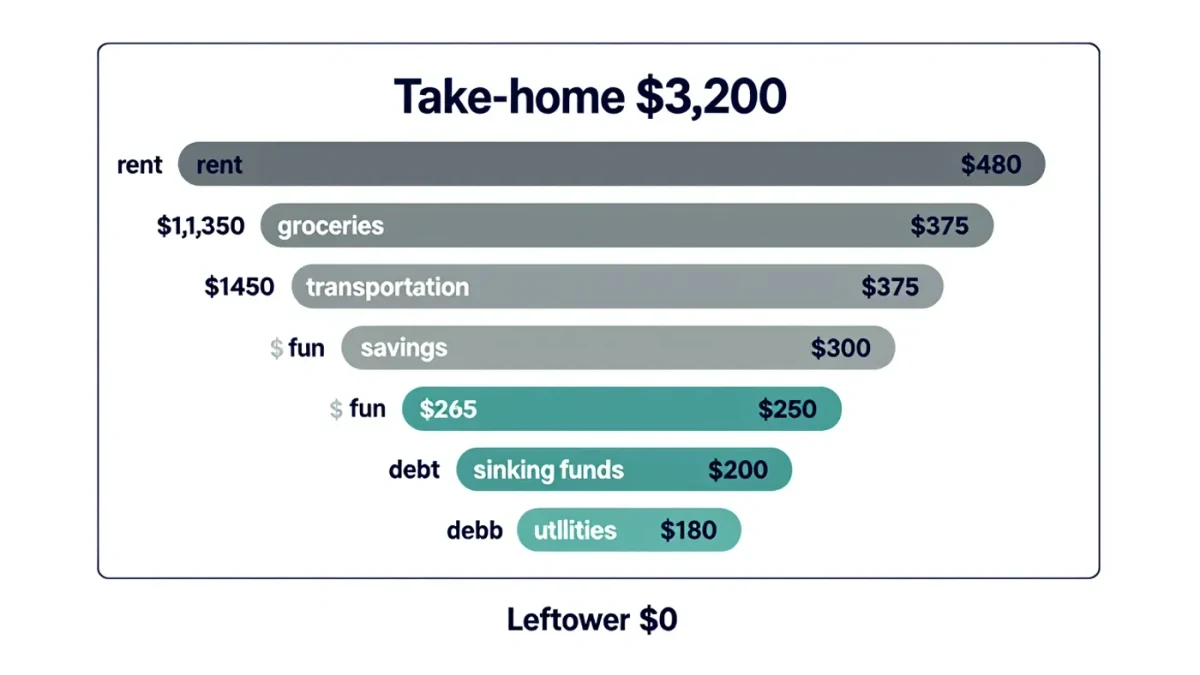
Zero-based budgeting means every dollar of income gets a specific assignment — spending, saving, or debt — until income minus assignments equals exactly zero. On a $3,200 take-home month, you do not budget about $3,200; you budget $3,200, to the dollar, deciding in advance that this forty dollars goes to a car repair fund and that ten covers a streaming plan. The method dates to corporate cost management, but it works at kitchen-table scale because unassigned money is where budgets leak.
SAMCASH publishes information, not financial advice — the right budgeting method depends on your income pattern and how much tracking you will honestly sustain.
How is it different from 50/30/20?
Granularity and timing. A 50/30/20 budget sets three ratios — roughly half of take-home to needs, a third to wants, a fifth to savings and debt — and lets categories float within them. Zero-based budgeting assigns every dollar before the month begins, so the plan is a map rather than a ratio. The ratio approach takes ten minutes a month; the zero-based approach takes a planning session plus mid-month check-ins. In exchange, nothing disappears untracked — the most common cause of quietly stalled savings.
How do you build one, step by step?
- Write expected take-home income for the month. If it varies, use your lowest realistic month.
- List fixed expenses first: rent, utilities, insurance, minimum debt payments.
- Add variable necessities: groceries, fuel, transportation.
- Fund sinking funds for known future bills — car registration, annual subscriptions, gifts.
- Assign what remains to wants, extra debt payoff, and savings until the leftover hits zero.
- Mid-month, move money between categories when reality argues; adjust the plan, not your integrity.
What does a finished month look like?
Here is a worked example on $3,200 of take-home pay, every dollar assigned: rent $1,150; utilities $180; groceries $480; transportation $375; minimum debt payments $250; sinking funds $200; dining and fun $265; extra savings transfer $300. Total: $3,200, leftover: $0. Nothing in the list is a rule — swap the numbers for your own life, keep the discipline of the zero.
| Category | Assignment | Share |
|---|---|---|
| Rent | $1,150 | 36% |
| Utilities | $180 | 6% |
| Groceries | $480 | 15% |
| Transportation | $375 | 12% |
| Minimum debt payments | $250 | 8% |
| Sinking funds | $200 | 6% |
| Dining and fun | $265 | 8% |
| Extra savings | $300 | 9% |
Assumptions: single household, fixed rent, one auto loan minimum; shares rounded. Your categories will differ — the zero at the bottom is the method.
What are the honest downsides?
It asks for attention. The first two months typically take three or four planning hours, irregular income adds guesswork, and shared households need both spenders in the system or the zero is fiction. The method can also shade into rigidity — if a category overrun feels like failure, people quit entirely. The fix is built into step six: moving dollars between categories during the month is the method working, not the method failing.
What mistakes sink zero-based budgets?
Forgetting the irregular bills is the number-one killer — annual insurance, holiday gifts, and car registration arrive on schedule, so they belong as monthly sinking-fund assignments, not as surprises. The second is planning for an aspirational income instead of the real one; assign dollars you actually received, and give every windfall its prewritten job. The third is abandoning the month after one overrun instead of rebalancing — the zero is rebuilt mid-month by moving assignments, and a rebuilt zero still counts.
Who is it best for?
Households trying to accelerate debt payoff, anyone saving toward a named goal with a deadline, and people whose money genuinely vanishes without a trace. If your finances are simple and stable, a ratio budget may deliver most of the benefit for a fraction of the effort. Many households run zero-based for a year, learn their real patterns, then graduate to lighter maintenance.
How does zero-based budgeting handle irregular income?
You budget the floor, not the forecast. A freelancer or server whose take-home swings between $2,600 and $3,800 builds the month on $2,600 — every dollar of that gets assignments — and treats months that land higher as bonus months with a prewritten rule: fill the emergency fund to one month of expenses, then attack the highest-rate debt, then fund the named goal. The prewritten rule is the trick. Without it, surplus months evaporate into restaurants and regret; with it, variability becomes an engine instead of an excuse.
What does month three feel like?
Shorter than month one. The planning session shrinks as categories stabilize, the mid-month check becomes a five-minute scan, and the ending zero starts arriving without heroics. Most quitters quit in the first six weeks, when the method still feels like homework; the households that reach month three usually keep some version of it for years, because the payoff — money behaving the way it was told — compounds alongside the savings themselves.
FAQ
Does zero-based mean I spend everything?
No — saving is an assignment. A dollar sent to a high-yield account on the first of the month has a job, and it counts toward the zero just like rent. The equation is income minus assignments equals zero, not income minus spending.
What about surprise expenses?
Two layers handle them: sinking funds for the predictable surprises — car repairs, medical copays — and a small unassigned buffer category for the genuine bolt-from-the-blue. If the buffer goes unspent, assign it to savings at month's end.
Can I use zero-based budgeting with an app?
Yes, and most people should. Apps built around giving every dollar a job do the arithmetic and roll overs automatically; a spreadsheet works too but demands more upkeep. The method is the zero, not the software.