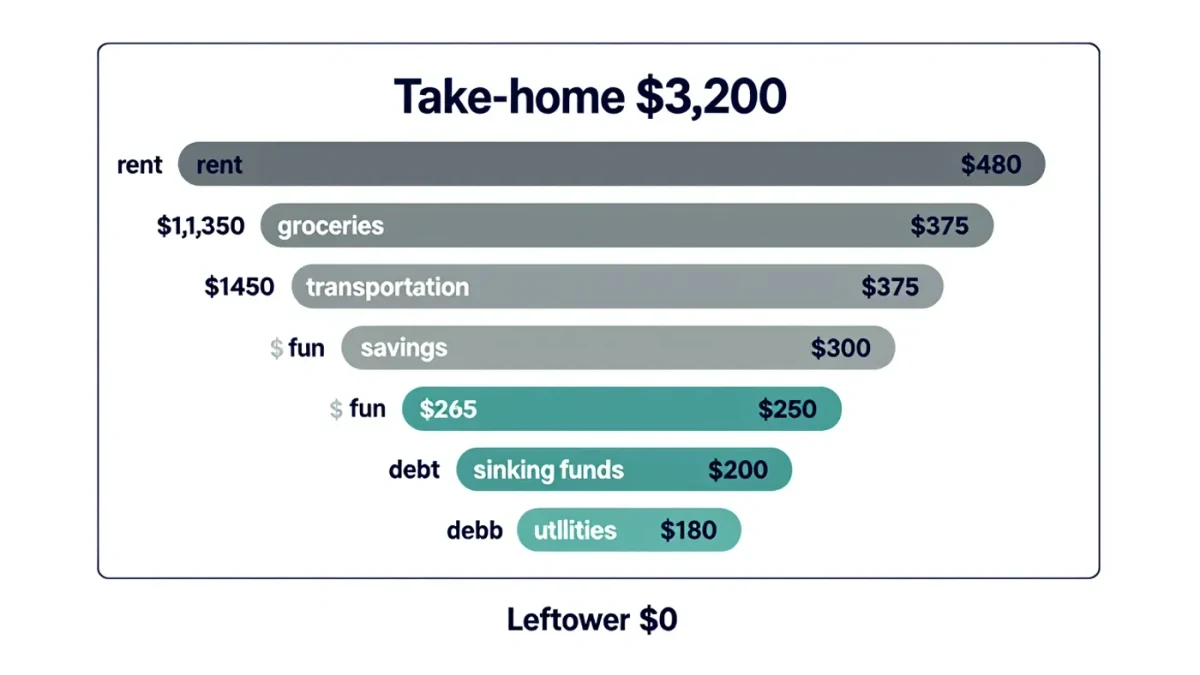

The 50/30/20 budget divides after-tax income into three buckets: roughly 50% to needs, 30% to wants, and 20% to savings and extra debt payoff. On $3,200 of monthly take-home pay that is $1,600 for rent, groceries, and insurance; $960 for dining, streaming, and hobbies; and $640 toward the emergency fund and beyond-minimum debt payments. The rule has survived two decades of budgeting fads for one reason: it takes an hour to set up and one glance a month to run, while stricter methods demand receipts and stamina.
SAMCASH publishes information, not financial advice — ratios are starting points, and your housing costs, debt load, and goals decide where they should bend.
What counts as a need?
Spending you cannot avoid without major consequence: rent or mortgage, utilities, groceries, insurance, transportation to work, childcare that enables work, and the minimum payments on every debt. Note the word minimum — extra debt payoff belongs to the 20% bucket, which is what makes the framework honest about credit cards. A $60 minimum on a card is a need; the $200 you add to kill the balance faster is a savings-bucket choice, and it competes well there, because few savings earn a guaranteed 20%+ return.
What counts as a want — and why 30% is generous?
Everything you could cancel with inconvenience rather than harm: dining out, subscriptions, travel, gear, gifts beyond the obligatory. Thirty percent of take-home is deliberately roomy — $960 in our example — because a budget that allows no joy gets abandoned by March. The roominess is also the diagnostic: when needs exceed 50%, the want bucket is where the arithmetic hides it, and the fix conversation starts there.
What goes in the 20% bucket?
Money that improves your future position: emergency fund deposits, retirement contributions, extra principal on debts, and saving for named goals. Order of operations inside the bucket travels well: a starter emergency reserve first, any employer 401(k) match second — the match is an immediate return — then high-rate debt, then long-term investing. A 401(k) contribution of 6% on a $60,000 salary parks $3,600 a year in this bucket before growth.
| Bucket | Share | On $3,200 take-home | Examples |
|---|---|---|---|
| Needs | 50% | $1,600 | Rent $1,150, utilities $180, groceries $270 |
| Wants | 30% | $960 | Dining $320, subscriptions $85, fun $555 |
| Savings & debt | 20% | $640 | Emergency fund $300, extra card payoff $200, IRA $140 |
Illustrative split — your dollar figures will differ, and the sub-amounts inside each bucket simply have to add up.
What if needs cost more than 50%?
In high-rent cities they often do, and pretending otherwise is where the method fails honest people. Run the numbers, then rebalance the ratios instead of the truth: a 60/20/20 version on $3,200 moves $320 from wants to needs; a 65/20/15 trims the future bucket too, which is survivable for a season and corrosious over years. The structural fixes — housing, transportation, income — matter more than the ratio itself, and the ratio's job is to show you the pressure, not to shame you for it.
How do you set it up in one sitting?
- Pull last month's after-tax income — the number that actually landed.
- List spending into the three buckets; minimums count as needs, everything discretionary as wants.
- Compare each bucket's real share to the target and pick the one number you will change this month.
- Automate the 20%: a payday transfer to savings and a recurring extra debt payment.
- Re-run the list monthly for three months; the third month's shares are your true baseline.
Where does 50/30/20 fall short?
Three places, honestly. It does not prioritize debt — a household with card balances at 22% should tilt the 20% bucket hard toward payoff and probably shrink wants below 30% for a stretch. It is lumpy-cost blind: annual bills need a sinking fund inside the wants or needs bucket, or December wrecks the ratio. And it uses after-tax income, which hides a big lever — paycheck withholding adjustments live upstream of the budget entirely. For households needing finer control, zero-based budgeting assigns every dollar a job; 50/30/20 trades that precision for durability.
How does the rule handle windfalls and bonuses?
Give them a prewritten split before they arrive — a common one is 70% to the 20% bucket's goals and 30% to wants, so the bonus accelerates the future without feeling confiscated. Without a rule written in advance, windfalls default to wants by gravity, and the ratio quietly degrades all year while the budget looks blameless on paper.
FAQ
Is 50/30/20 realistic on a low income?
The ratios struggle when needs alone exceed 60% of pay. Keep the structure — it still shows you the pressure points — but treat 20% savings as a ramp rather than a rule: start at 5% and raise it a point a year as income grows.
Does the 20% include my 401(k) contribution?
Yes — retirement contributions, emergency savings, and extra debt payments all count in the 20% bucket. A 6% deferral plus a 4% match puts 10% of gross in before you add anything else, which makes the remaining 10% of take-home easier than it sounds.
Should I track 50/30/20 with an app?
A monthly snapshot is the spirit of the method: one sitting, three totals, one adjustment. Apps that categorize automatically make the snapshot faster; daily receipt-tracking belongs to stricter systems, and importing that burden here usually breaks the habit the method was chosen for.