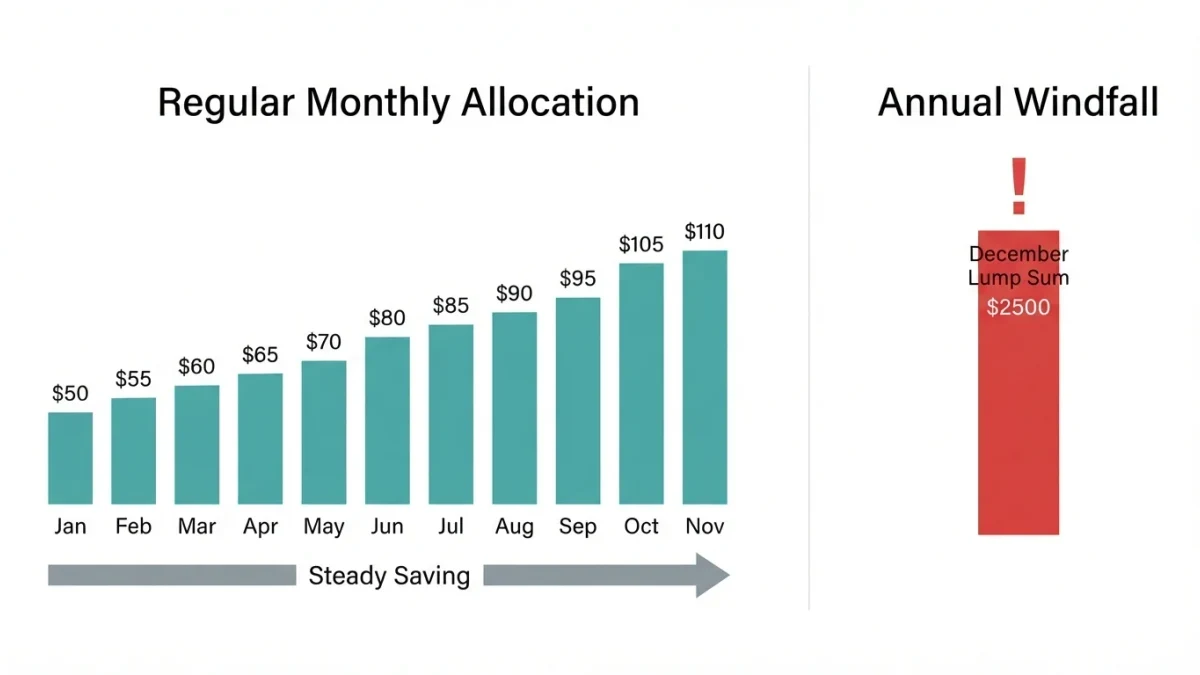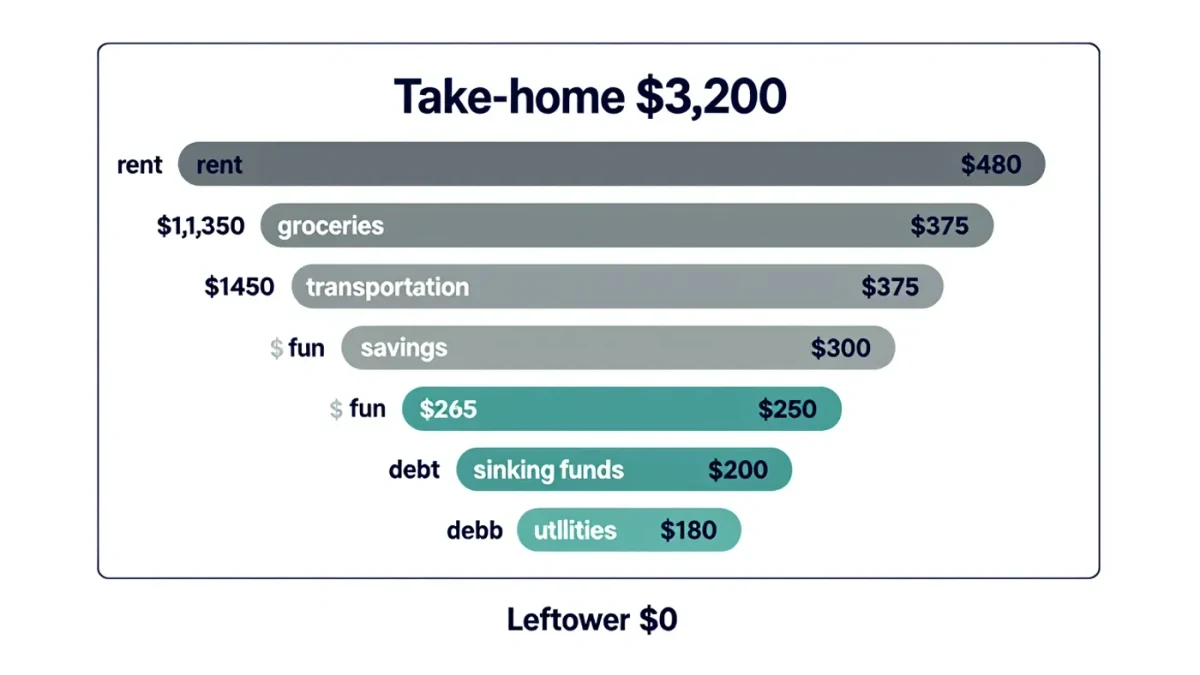

A sinking fund is a category of savings earmarked for a specific expense you know is coming and roughly when: $50 a month all year becomes the $600 car insurance bill that lands each January without drama. The name comes from corporate finance — companies sank money into funds to retire future bond debt — but the household version is simpler: divide each known irregular expense by the months until it arrives, save that amount monthly, and pay the bill from the fund instead of from the month's paycheck. Where an emergency fund answers surprises, sinking funds answer scheduled events you simply had not scheduled.
SAMCASH publishes information, not financial advice — which funds to run and how much to save depend on your actual bills and calendar.
Which expenses deserve a sinking fund?
Anything that arrives irregularly or annually but predictably. The starter set for most households: car insurance and registration, holiday and birthday gifts, annual subscriptions and memberships, car maintenance and tires, medical deductibles, home repairs (the rule of thumb budgets 1% to 2% of home value per year), back-to-school costs, pet care, travel, and the holiday season as its own line — December deserves a fund precisely because it is the most predictable budget-breaker on the calendar.
| Fund | Typical target | Monthly save over 12 months |
|---|---|---|
| Holidays and gifts | $1,200 | $100 |
| Car insurance (paid in full) | $1,080 | $90 |
| Car maintenance and tires | $720 | $60 |
| Home repairs | $2,400 | $200 |
| Medical deductible | $1,500 | $125 |
| Vacation | $1,800 | $150 |
Targets are illustrative — build yours from last year's actual bills, bank statements being the honest source.
How do you set one up?
- Inventory the irregulars: scan twelve months of statements for everything that did not happen monthly.
- Total each category and divide by twelve (or by the months until the next occurrence for one-off items).
- Open sub-savings accounts — most online banks allow several nicknamed accounts — or track categories in one account with a spreadsheet column each.
- Automate the transfers for payday, before spending can see the money.
- When the bill arrives, pay it from the fund, then recompute the monthly save from this year's actual price.
Sinking funds versus the emergency fund — what is the difference?
Predictability. Emergency funds answer unknown-what, unknown-when events — job loss, the surprise surgery, the failed transmission nobody scheduled. Sinking funds answer known-what, known-when events. Keeping them separate keeps both honest: a used sinking fund that gets refilled is a working machine, while an emergency fund spent on a predictable insurance bill was never an emergency fund at all — it was an unbudgeted expense wearing a costume. If the insurance bill surprises you annually, the problem is not luck.
How do they interact with debt payoff?
Tensely, and the resolution is a tiered list. Minimums on all debts come first; a starter emergency fund (even $500 to $1,000) comes second; then the honest order runs aggressive extra debt payments alongside lean sinking funds for the nearest bills — the car registration due in March needs its $30 a month whatever the card balance says. Skip every fund and charge the surprises, and the debt loop never closes: the 24% APR card reabsorbs whatever snowball method sends its way, because emergencies priced at 24% compound faster than extra payments. Sinking funds are, in that sense, debt-payoff infrastructure.
Where should the money sit?
In savings, uninvested. A bill arriving in nine months cannot tolerate a market drawdown, so high-yield savings or a short CD ladder is correct — and at the roughly 4% top online accounts paid into 2026, the float is not nothing: $5,000 across funds earns about $200 a year while it waits. Labeling matters more than yield: named accounts get funded and unnamed ones get raided, so the extra minute spent naming each fund buys real compliance.
FAQ
How many sinking funds is too many?
When tracking overhead exceeds attention, consolidate: one vehicle-and-home fund and one life-events fund cover most households fine. The number of accounts is cosmetic; the discipline is assigning dollars to named future bills instead of hoping the month cooperates.
What if I am starting mid-year, close to the bill?
Divide by the months you actually have — the $1,200 holiday fund started in September needs $400 a month, which is exactly the moment the insight lands hardest. Fund the near bills aggressively, then relax to the twelve-month spread after the first cycle clears.
Should sinking funds be automated?
Yes — the automation is most of the benefit. Transfers that run the day after payday convert a discipline problem into an arithmetic one, and the fund refills itself without any month containing a decision to make.