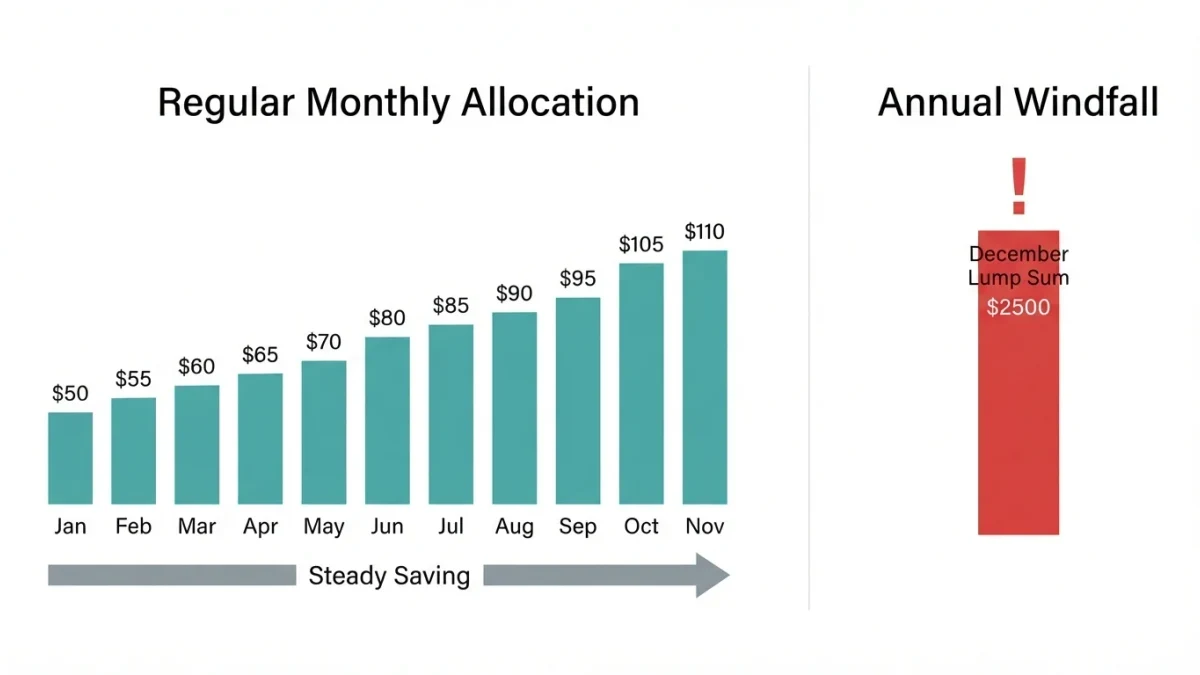
The holidays wreck budgets for one structural reason: a full year's worth of gift, travel, and hosting expenses arrives in a single month. The average American household plans to spend roughly $1,000 on winter holidays, per National Retail Federation surveys — $1,000 in December is a crisis, but $83.33 a month starting in January is a rounding error. That inversion is the entire method: set the number now, when December is an abstraction, and automate small saves toward it all year, so the season is funded before the first decoration appears.
SAMCASH publishes information, not financial advice — holiday spending is deeply personal and family-shaped, and the right number is whatever you decide without pressure, not a benchmark to match.
Why start in January rather than October?
Because the money must be boring before the season gets exciting. A January start saves $1,000 at $83 a month; an October start needs $333 a month — quadruple the load, arriving exactly when budgets are tightest. Starting early also buys planning discounts: flights and gifts bought in off-peak months price below December's peak, and spreading purchases across sales cycles beats one panicked weekend at the mall. The cheapest holiday is the one assembled gradually by a person who planned it, not the one financed at 24% by a credit card in December.
How do you set the target number?
- Reconstruct last January-through-December holiday spend honestly — gifts, travel, hosting, decorations, tips, the cards, everything — from statements.
- Add the known changes: a new niece, a planned trip, a family year of hosting.
- Set the total you want, divide by 11 (January through November — fund it before the season starts), and automate the transfer to a dedicated savings account.
- Name the account — Holiday 2026 — because labeled accounts get funded and generic ones get raided.
- Recheck at midyear: adjust once in July with real information, not weekly with anxiety.
What goes in the number?
Everything the season actually costs, which is where most budgets undershoot. The gift list is the visible third; the rest is travel and lodging, groceries and hosting beyond normal meal budgets, decorations and wrapping, year-end tips for service providers, holiday cards and postage, charitable giving in its seasonal spike, and the January sales you will swear are for next year. A $1,000 fund that forgets the $300 of travel and the $150 of hosting is a $1,450 season charged at 24% for its last act.
| Holiday line | Illustrative annual target | Monthly save (Jan–Nov) |
|---|---|---|
| Gifts | $600 | $55 |
| Travel and lodging | $400 | $36 |
| Hosting and special meals | $200 | $18 |
| Decorations and wrapping | $100 | $9 |
| Tips, cards, charity | $200 | $18 |
| Total | $1,500 | ≈ $136 |
Illustrative targets — build yours from your own last-season statements, the honest source of what your family's holidays cost.
How do you keep the fund honest in December?
With a spend-down plan, not a balance. List recipients and amounts before shopping, keep a running total as purchases land, and treat the fund's balance as the hard ceiling it was built to be — an empty holiday fund in mid-December means the list shrinks, not the card balance grows. The cash-envelope version works well for gift shopping specifically: withdraw the gift allocation, spend it down, stop when it is gone. And whatever is left in January sweeps to next year's fund as its opening deposit, which is how the second year costs even less effort than the first.
How does this interact with the rest of the budget?
Cleanly, if the fund has its own line. In a 50/30/20 frame, holiday saving belongs to the 20% bucket alongside other sinking funds and goals — not to December's emergency improvisation. Households running zero-based budgets simply create the assignment — Holiday $136 — and the rest of the plan absorbs it as one more named job for dollars. The failure mode to avoid is funding holidays from the emergency reserve: December is not an emergency, it is a calendar date, and dates get sinking funds.
What if I am reading this mid-year?
Start anyway, at the accelerated rate: a July start needs $188 a month for the same $1,500, which is harder than $136 and dramatically easier than December's everything-at-once. Every month of runway removed from December is interest never paid and stress never incurred. The perfect month to start a holiday fund is January; the second-best is this one.
And the years compound, not just the months: the second January opens with the leftover sweep already inside, the gift list already proven, and the habit already automatic. A family that runs the loop twice typically stops thinking about holiday money at all — which is the entire point, December having finally become what it should have been all along: a month the budget already contains.
FAQ
Where should the holiday fund sit?
A named high-yield savings account — liquid, insulated from checking, earning roughly 4% at top online banks into 2026 while it waits. Eleven months at that rate on a $1,500 average balance adds about $50 the fund would not otherwise have.
Should I buy gifts early when I see deals?
Within the fund and the list, yes — off-peak pricing is the dividend of early planning. Keep a simple hiding-and-tracking system, or you will buy the same sweater twice in October for people you forgot you covered in March.
How do I handle family expectations bigger than my budget?
Out loud and early. A November conversation about scaled-back exchanges, price caps, or names-drawn-gifts lands as maturity, and January is the easiest month to propose it for next year. The budget's job is to fund your actual family, not an obligation nobody said out loud.