Budget for a car by totaling five costs, not one: financing, insurance, fuel, maintenance and registration, and depreciation — the silent loss as the vehicle loses value. The old 20% rule of thumb caps total car costs at 20% of take-home pay and the payment itself at 10%, but the honest version counts the invisible lines too, because a $600 payment sitting next to $380 of insurance, gas, and upkeep is a $980-a-month decision. On $4,000 of monthly take-home, the whole-car ceiling is about $800 — and that number, not the dealer's, is the budget.
What does ownership really cost per month?
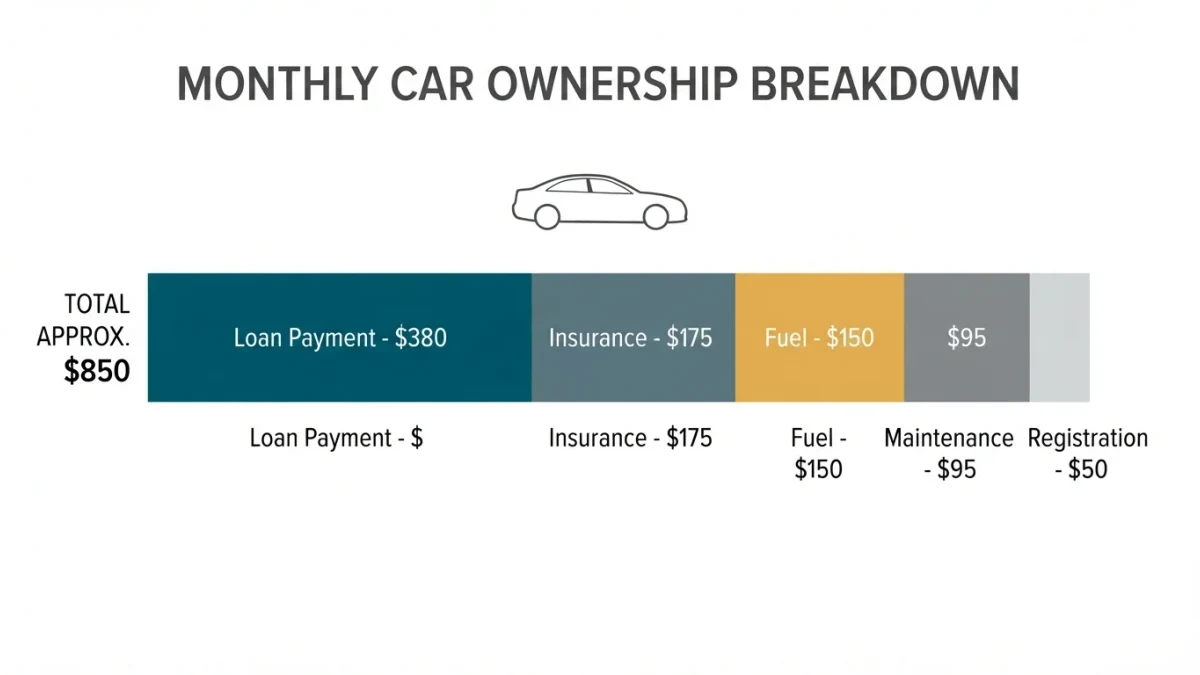
Run a worked example with stated assumptions — a $28,000 used crossover, financed used at an assumed 7% APR for 60 months after a $3,000 down payment: the payment is about $460, since $25,000 at 7% over five years amortizes to roughly $495 — call it $460 with the $3,000 reducing the amount. Alongside it: insurance for full coverage at an assumed $165, fuel at an assumed 1,000 miles a month and 30 mpg at $3.40 a gallon (about $115), maintenance and tires at an assumed $90, registration averaging to $20. Total: roughly $850 a month before depreciation — and depreciation alone can run $300 or more in the early years.
| Cost line | Assumed amount | Notes |
|---|---|---|
| Loan payment | $460 | $25,000 at 7% APR, 60 months |
| Insurance | $165 | Full coverage varies by state and driver |
| Fuel | $115 | 1,000 miles at 30 mpg, $3.40/gal |
| Maintenance & tires | $90 | Averaged over ownership |
| Registration | $20 | Annualized |
| Total | ≈ $850 | Before depreciation |
All figures are illustrative assumptions — price your own insurance and local fuel before signing anything, and note that insurance has been one of the fastest-rising car costs of recent years.
How much down payment — and how long a loan?
Put 20% down on used, 10% on new if you can, and keep the loan inside 60 months. The down payment shrinks the interest bill and starts you above water — owing less than the car is worth — which matters because gap between loan and value is where trade-in traps live. Longer loans cut the payment but invert the arithmetic: at 84 months the same $25,000 at 7% costs about $3,700 more in interest than at 60, and the car depreciates faster than the balance falls for most of the term.
New, used, or lease?
Used wins most budgets: the first owner absorbs the steepest depreciation — new vehicles can lose a quarter of value in two years — so a 2-to-4-year-old vehicle delivers most of the utility at a fraction of the lifetime cost. New makes sense for keepers who value the full warranty and plan a decade of ownership. Leasing looks cheap monthly but is a perpetual-payment structure with mileage caps; it suits people who reliably want a new car every three years and can document predictable mileage — not households optimizing total cost.
What is the total-cost shopping checklist?
- Quote insurance on the exact model and trim before visiting a dealer — the spread between similar cars runs hundreds a year.
- Check the model's fuel economy and repair record; reliability is a budget line, not a luxury.
- Price financing outside the dealership first — bank or credit union preapproval turns the dealer's rate into a benchmark rather than a default.
- Set the total-cost ceiling from your budget before setting foot on the lot, and let the payment follow the ceiling, never the reverse.
- Time the purchase: model-year-end and holiday periods move prices; end-of-month quotas help on new cars.
How do you save for the next one?
With a sinking fund, started the month the loan ends: continue the payment amount into savings — $460 a month for four years at an assumed 4% APY builds about $23,900, enough to buy the next car nearly in cash and delete the interest line forever. Households that run this loop once rarely go back to perpetual car payments, and the discipline costs nothing beyond keeping the habit after the lender is gone.
How does a car payment interact with the rest of a budget?
As a fixed obligation with a multi-year lease on your future income — which is why lenders count it so heavily in debt-to-income math, and why a car decision quietly shapes the next housing decision. On a $4,000 take-home, an $850 all-in car cost is more than 20%; adding a $1,400 rent payment pushes combined fixed costs past half of income before food appears. The practical sequencing: keep the car total under the 20% line even when the payment alone looks modest, and remember that the sinking-fund habit — paying the car to yourself after the loan ends — is what permanently frees that fifth of the budget for the next goal.
FAQ
How much car can I afford on my salary?
Keep all car costs — payment, insurance, fuel, upkeep — at or under 20% of take-home pay, and ideally closer to 15% when rent is heavy. On $4,000 take-home that is $600 to $800 all-in, which usually prices a reliable used vehicle better than a new one.
Is a bigger down payment always better?
Almost always — it cuts interest, lowers the payment, and protects against negative equity. The exception is draining your emergency fund to do it: a funded reserve beats a smaller loan, because repairs and job surprises do not care about your lien.
Should I take the dealer's financing rebate?
Compare the full math: sometimes a rebate with outside financing beats the dealer's promotional rate, and sometimes the zero-percent offer wins outright. Preapproval plus one honest comparison calculation — total of payments, both ways — settles it in five minutes.