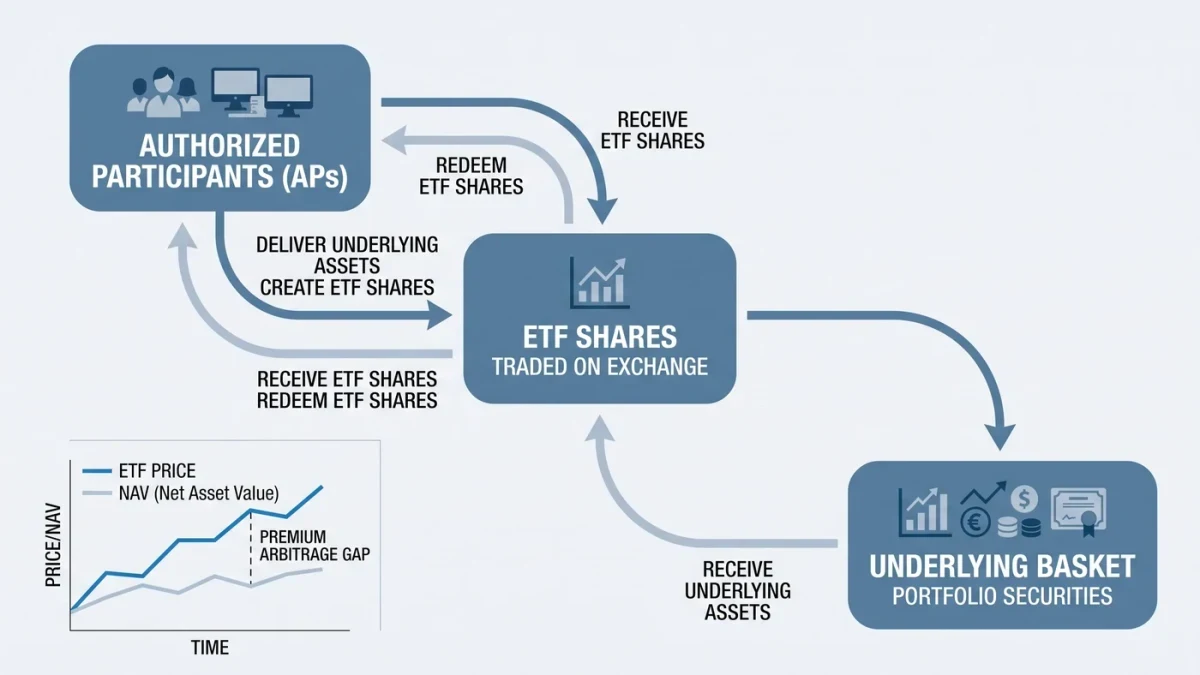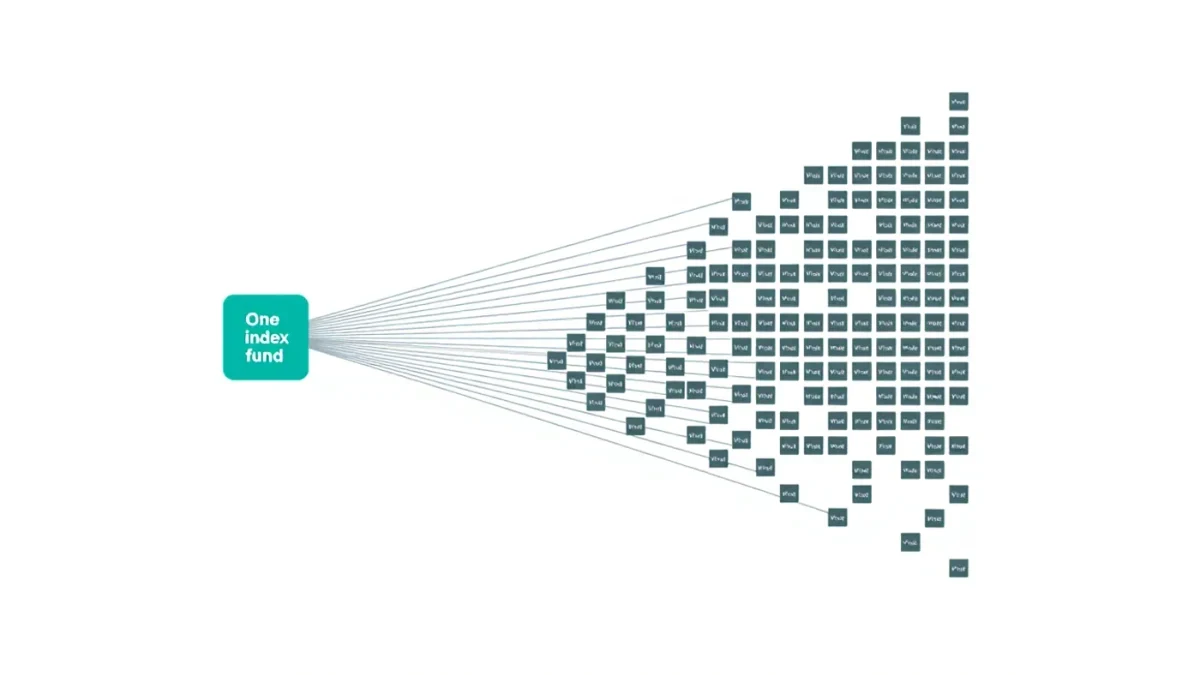

An ETF — exchange-traded fund — and a mutual fund both pool many investors' money into a single diversified basket run to an index or strategy. The difference is plumbing: a mutual fund prices once a day after the market closes, while an ETF trades all day on an exchange like a stock, its price ticking with supply and demand around the value of its holdings. That single mechanical difference drives most of the practical trade-offs — cost, taxes, automation, and how your order fills.
SAMCASH publishes information, not financial advice and does not tell you what to buy — this is a comparison of wrappers so you can match one to your own situation.
How are they structurally different?
Mutual funds are bought from the fund company at the day's closing net asset value; whatever time you place the order, everyone that day gets the same price. ETFs are bought from other investors on an exchange at a live market price, which can sit a hair above or below the underlying value — the premium or discount, usually pennies on liquid funds. Neither is riskier by design; both hold identical kinds of assets underneath, and the cheapest funds of each type charge a few dollars a year per $10,000 invested.
| Feature | ETF | Mutual fund |
|---|---|---|
| When it trades | All day at market price | Once daily at closing NAV |
| Minimum investment | Price of one share, or less with fractional | Often $0–$3,000 |
| Typical index-fund fees | Among the lowest available | Equally low at the best providers |
| Automatic investing | Supported at most brokers, with quirks | The classic default, including 401(k)s |
| Taxes in taxable accounts | Usually smaller capital-gains distributions | Annual distributions can create tax bills |
| In 401(k) plans | Rare | Standard |
Fee note: compare specific funds, not averages — broad index funds of both types now charge under 0.10% at the largest providers.
Why does the tax difference matter?
In a regular taxable account, mutual funds must sell holdings when shareholders redeem, and the resulting capital gains get distributed to everyone remaining — you can owe tax on a gain you never personally booked, even in a year your fund fell. ETFs mostly avoid this through an in-kind mechanism that sheds shares without triggering sales, so their distributions are typically smaller. Inside an IRA or 401(k) the point evaporates — tax-sheltered accounts make both wrappers equal on taxes, which is why the 401(k) menu's mutual funds cost you nothing.
Which one should a beginner choose?
Match the wrapper to the account. In a workplace 401(k), you will use mutual funds — or their collective investment trust cousins — because that is what the menu offers. In an IRA at a brokerage, either works; the broadest, cheapest fund you will actually automate is the right answer. In a taxable brokerage account, the ETF's tax edge and all-day trading argue in its favor, provided your broker supports fractional shares — otherwise one share of a $500 fund forces lumpy purchases, and the mutual fund's exact-dollar investing keeps a monthly rhythm intact.
Where do people go wrong?
Three habits corrode returns. Trading ETFs just because they trade — intraday pricing is a convenience, not an invitation, and the buy-and-hold math beats the in-and-out math across decades. Chasing exotic ETFs — leveraged, inverse, single-theme — that use the same wrapper to package entirely different risk. And reflexively avoiding mutual funds in retirement accounts where the tax argument does not apply, paying needless attention to a difference that does not exist there.
FAQ
Are ETFs riskier than mutual funds?
No — risk lives in what the fund holds, not the wrapper. An ETF and a mutual fund tracking the same index have nearly identical ups and downs; the differences are trading mechanics, costs, and tax handling.
Can I convert a mutual fund to an ETF?
Some providers offer in-kind conversions within their own fund families without triggering capital gains; otherwise selling a mutual fund in a taxable account may realize gains. Check the provider's conversion program before selling anything.
Which is better for automatic monthly investing?
Mutual funds were built for it — dollar amounts buy exact fractions at the closing price. Most large brokers now automate ETF purchases too, and fractional shares close the gap; choose the fund you will stick with and let the automation question follow.