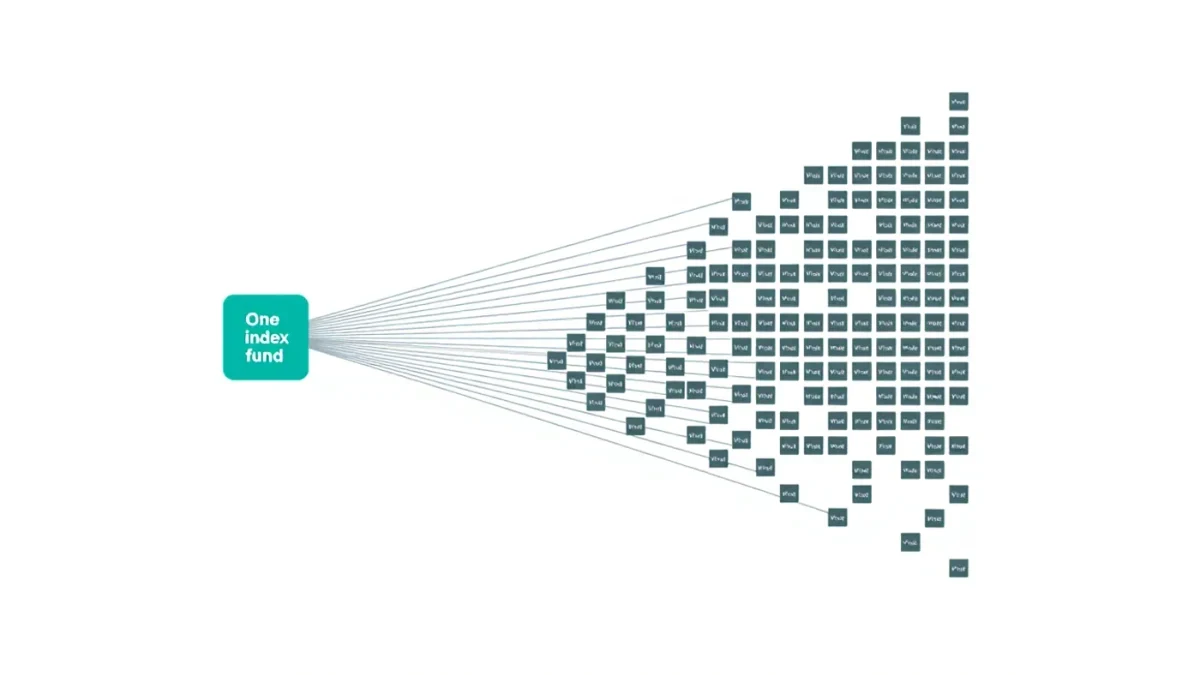
An index fund is a mutual fund or ETF that owns every security in a published market index — a total-market fund holds essentially the entire US stock market, hundreds of companies in one purchase — and simply aims to match that index's return instead of trying to beat it. Because no analysts pick stocks and little trading happens, annual expenses run low; broad index funds commonly charge a fraction of a percent a year. Over long periods, cheap market-matching has beaten most professionally managed large-stock funds, which is the quiet argument for starting here.
SAMCASH publishes information, not financial advice and does not tell you what to buy — this article explains how the product works so you can choose your own funds.
What is an index, exactly?
A list of companies built by published rules. A total-market index includes nearly all publicly traded US stocks weighted by size; other indexes cover large companies, the bond market, or international stocks. The index is just math — no manager — and a fund tracking it holds what the list holds, in the same proportions. When you buy one share of a total-market fund, you own a slice of the entire American stock market, from the largest company to firms most people have never heard of.
Why does the low fee matter so much?
Fees compound against you every year, in every market. The expense ratio is quoted as a percentage: a fund charging 0.03% costs $3 a year per $10,000 invested, while a fund charging 0.75% costs $75 on the same balance. On a $50,000 portfolio held for twenty years, that difference is roughly $36,000 at an assumed 6% average annual return — the cheaper fund keeps money compounding for you instead of deducting it. Check any fund's fee on its own fact sheet before buying; lower is simply better for the same exposure.
| Annual fee on $10,000 | 0.03% index fund | 0.75% active fund |
|---|---|---|
| Yearly cost | $3 | $75 |
| 20-year cost at 6% assumed growth | ≈ $1,000 | ≈ $25,000 |
Assumptions: balances grow at an assumed 6% average annual return, fees deducted annually, no contributions. Illustration only — returns are not guaranteed.
What are the types a beginner meets?
Four broad families cover most needs. Total US market funds own nearly everything listed in the United States. Large-company funds track the best-known indexes of the biggest firms. Total international funds own non-US markets. Total bond funds hold the investment-grade bond market. A simple portfolio can be one total-market fund or a pair of stock and bond funds — the fewer moving parts, the easier it is to leave alone, and leaving it alone is most of the job.
How do you actually buy one?
Inside a brokerage or retirement account. Search the fund's name or ticker, check the expense ratio and minimum, and enter a dollar amount — fractional shares mean $100 buys a partial share of even the priciest fund. In workplace 401(k)s, the menu is preset: look for the broadest, cheapest stock index fund offered and the target-date fund as the one-click alternative. Either route takes minutes, and automatic monthly purchases remove the temptation to time the market.
What can go wrong?
Not what headlines suggest, but three real things. Buying a niche fund labeled index — semiconductor-only, single-country — because it is not diversification, just a themed bet with the same low-fee wrapper. Trading in and out of even a perfect index fund, converting its long-term advantage into transaction guesswork. And panicking in a bear market: an index fund guarantees you participate fully in falls as well as rises, which is the price of owning the whole market. The remedy for all three is the same — broad funds, automatic purchases, and a horizon measured in years.
FAQ
Do index funds pay dividends?
Most do — the companies in the index pay dividends, and the fund passes them through as distributions, typically quarterly. Reinvesting them, which most brokerages do automatically, buys more shares and compounds growth.
Index fund or ETF — which should I choose?
They are wrappers, not strategies: the same index is often available as either. ETFs trade all day and usually carry the lowest fees; mutual funds buy at the day's closing price and automate cleanly in 401(k)s. The index choice matters more than the wrapper.
Can an index fund fail?
The fund itself is diversified across hundreds of companies and regulated custody rules protect the assets. The real risk is market risk — the entire market can fall and stay down for years — which is why money needed within a few years does not belong in stock index funds at all.