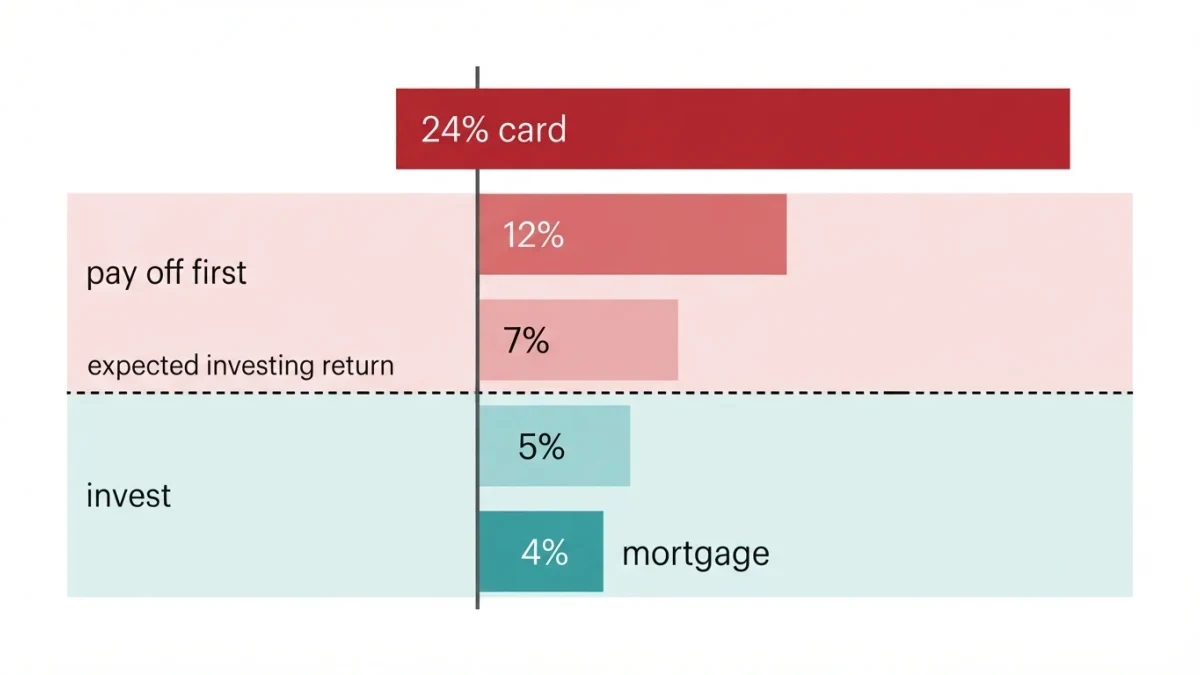
The invest-versus-payoff decision is an interest-rate comparison with two twists: the debt's rate is guaranteed and certain, while investing's return is an expectation that wobbles by decade. Paying off a 24% credit card is a guaranteed, risk-free 24% return — no diversified portfolio offers that, and none ever reliably has. Paying off a 4% mortgage instead of investing is a guaranteed 4% against a stock market that has averaged roughly 10% a year over long periods but with down decades along the way — a genuine judgment call that turns on taxes, timeline, and temperament. The method is mechanical; only the middle band is debatable.
SAMCASH publishes information, not financial advice — the right order depends on your rates, accounts, and tax picture, and rates cited are illustrations of the comparison, not predictions.
What is the priority order?
- Employer 401(k) match first — a 50%-100% immediate return outranks every debt, because no payoff or portfolio beats it.
- Starter emergency fund ($500–$1,000) — prevents new high-rate debt from filling the hole you are emptying.
- High-rate debt (cards, payday-style credit above roughly 8–10%) — attack hardest; the guaranteed return is unbeatable.
- Mid-band decisions (student loans, auto loans, mortgages below roughly 8%) — compare after-tax rates against your expected return and risk tolerance.
- Long-term investing ramps alongside low-rate debt — automate both when the rates say so.
How does the math work in the mid-band?
With stated assumptions. A $5,000 card balance at 24% costs $1,200 a year in interest — guaranteed, compounding against you; the same $5,000 in an index fund at an assumed 7% average expects $350, with real years ranging widely around it. Payoff wins by $850 before risk considerations, after which it only wins harder. A $5,000 student loan at 5% costs $250 a year; the fund's $350 expectation edges it, but with variance — a sequence of bad early years leaves the loan's certainty ahead. The crossover sits where your expected after-tax return roughly equals the debt's rate, which is why the 8%-ish boundary moves with your risk appetite and tax-deductibility: deductible mortgage or student-loan interest priced at, say, an effective 3.6% after a 28% combined bracket effect loses to most investing assumptions.
| Debt (rate) | Guaranteed payoff return | Versus assumed 7% investing | Call |
|---|---|---|---|
| Credit card (24%) | 24% | Beats it by 17 points | Pay off first |
| Personal loan (12%) | 12% | Beats it by 5 | Pay off first |
| Auto loan (7%) | 7% | Wash before risk | Judgment / split |
| Student loan (5%) | 5% | Loses by 2 | Invest, usually |
| Mortgage (4%, deductible) | ≈3% after tax | Loses by 4 | Invest |
Assumed returns are illustrations — investing returns are uncertain, and the payoff return never is.
What are the non-math arguments?
They are real, and they cut both ways. For payoff: the freed cash flow is permanent — a cleared $300 payment is a raise; the peace of a debt-free balance sheet has behavioral value money misses; payoff returns cannot be taken back by a bear market. For investing: time in the market does not return once lost — years of delayed contributions cost compounding decades later; retirement accounts have annual limits, so skipped years cannot be refilled; and inflation erodes fixed-rate debt while assets historically outgrow it. The honest synthesis: at high rates the math is decisive for payoff, at low rates decisive for investing, and in between the behavioral factor is not a tiebreaker to apologize for — the plan you will follow beats the plan that is theoretically optimal.
Can you do both at once?
Yes, and past the starter emergency fund it is often the right answer: capture the match, then split the surplus — half to the highest-rate debt, half to the investing habit — and re-balance the split as the debt clears. The split costs little in expected value at mid-band rates and buys something valuable: two systems running, so when the debt ends its payment rolls into an investing contribution that already exists, rather than a new habit that must be built from zero at the finish line.
What mistakes warp this decision?
Comparing the debt rate to last year's fund return instead of a long-run expectation. Ignoring tax treatment on both sides — deductible interest and retirement wrappers. Paying off low-rate, deductible mortgage debt while carrying any card balance, the single most common inversion. And stopping all investing for years to chase debt-freedom, arriving debt-free but contribution-poor — the match and the IRA limit do not wait. The order exists to prevent exactly these swaps.
FAQ
Should I withdraw investments to pay off cards?
Almost never from retirement accounts — taxes and 10%-style early-withdrawal penalties convert 24% debt into an effective 30%-plus cost. A taxable account holding low-basis winners gets a capital-gains comparison first; cash and new cash flow are the honest funding sources.
Does this change when the Fed cuts rates?
Slightly and slowly: floating debt reprices down with the Fed — cards barely, HELOCs fully — while expected market returns do not move in lockstep. The priority order barely moves; the mid-band boundary shifts a little with each cycle.
What about paying off the mortgage early for peace of mind?
Defensible at low rates only as a labeled choice: if the guaranteed after-tax savings beats your personal expected use of the money and you value the certainty, direct extra principal deliberately — while keeping retirement contributions running, because a paid-off house cannot be reverse-mortgaged into thirty years of missed compounding.