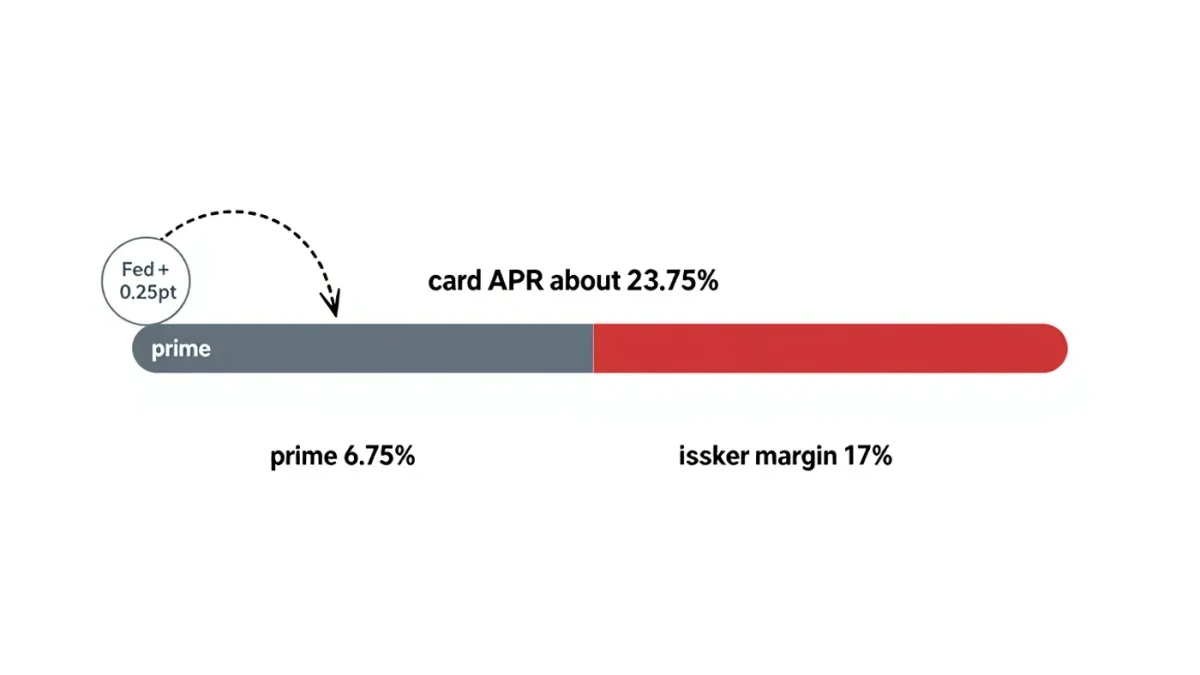
Credit card APRs ride a formula, not the Fed's press conference: most cards set their rate as the prime rate plus a margin set in your card agreement, so a Fed cut passes through almost fully — and almost meaninglessly. The Fed's December 2025 quarter-point cut moved the prime rate by a matching quarter point, turning a 24% card into roughly a 23.75% card. The margin — the part that keeps card rates in the 20s while savings rates sit in the 4s — is priced from default risk, rewards funding, and the competitive reality that card balances are sticky: issuers do not need to win rate shoppers because revolving balances rarely shop.
SAMCASH publishes information, not financial advice — card decisions depend on your balances, credit profile, and alternatives.
How does the prime-plus-margin structure work?
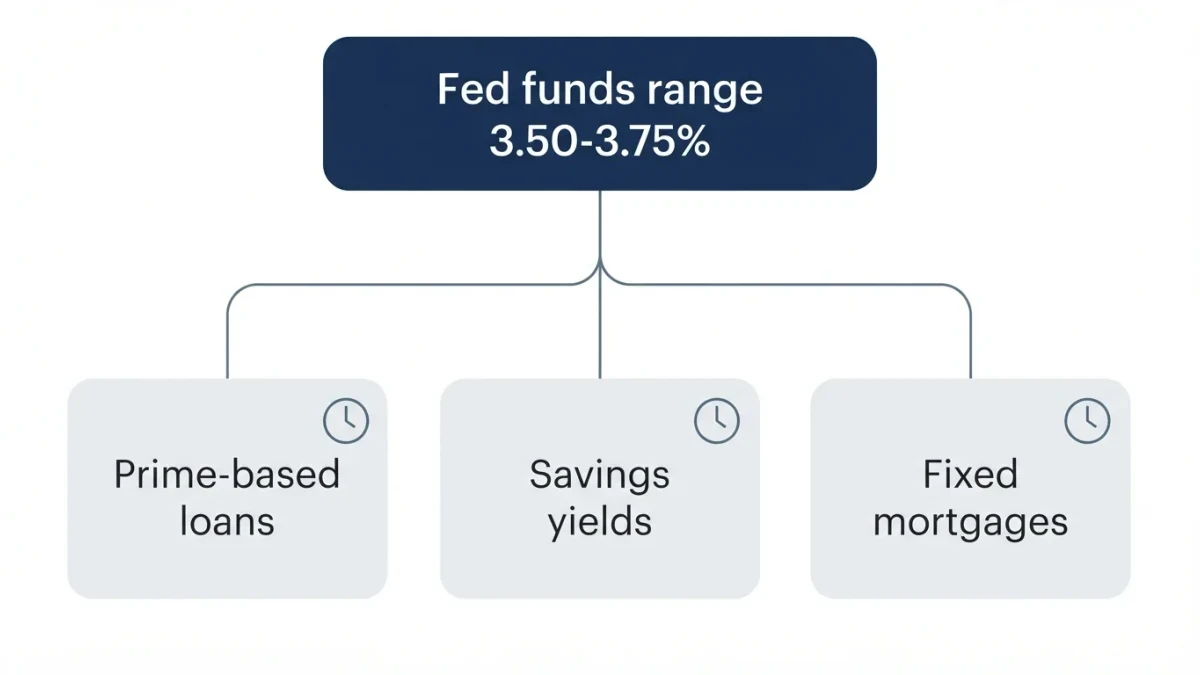
The prime rate is a benchmark banks quote, sitting by convention three points above the top of the Fed's target range — with the range at 3.50%–3.75% after the December 2025 cut, prime stands at 6.75%. A card contract reads variable APR: prime + 17.24%, and reprices automatically with each prime move, usually within a billing cycle or two. Nothing in that structure is secret; the margin is disclosed in the Schumer box on any card application. What the structure guarantees is symmetry: card rates follow the Fed down as mechanically as they followed it up — one-for-one, never catching up on the wide margin in between.
Why is the margin so wide?
Because card lending is unsecured, revolving, and default-prone at the margin — issuers price expected losses, rewards programs' cash-back funding, servicing, and profit into the spread. Competition disciplines the margin only weakly: rate-sensitive borrowers with strong credit can find cards in the mid-teens or intro-0% windows, while revolvers without that profile pay the sticker margin. The economics concentrate on the customers who revolve — households carrying balances month to month effectively fund the rewards earned by those who pay in full, a cross-subsidy worth knowing which side of you are on.
What does this mean in practice?
| Rate | Fed cuts 0.25 | Real-world effect |
|---|---|---|
| Card at prime + 17% | Falls to ~23.75% | $2,000 balance saves about $0.40 a month |
| HELOC at prime + 1% | Falls to 7.75% | Meaningful on large balances |
| High-yield savings | Drifts lower | Fewer dollars earned, gradually |
Balance math: a $2,000 card balance at 24% costs about $40 a month in interest; the Fed's quarter point returns roughly forty cents of it. Waiting for the Fed to rescue a card balance is a category error — the rescue arrives from the borrower's side, not the FOMC's.
What actually lowers what you pay?
- Pay the balance — the only move that zeroes the APR. Even fixed extra payments above minimums collapse the interest line quickly, because card interest accrues on the average daily balance you no longer carry.
- Transfer the balance to a 0%-intro card — typically 12 to 21 months at zero with a 3%-5% one-time fee — which converts 24% interest into a fee schedule with a deadline. The deadline is the trap: mark it and clear it.
- Ask your issuer for a rate reduction — a phone call that succeeds surprisingly often for long customers with payment history, worth ten minutes before any balance transfer.
- Shop prime-plus-low-margin cards — credit unions routinely price cards in the mid-teens, and strong credit unlocks them.
Where do card rates stand after the 2025-2026 cycle?
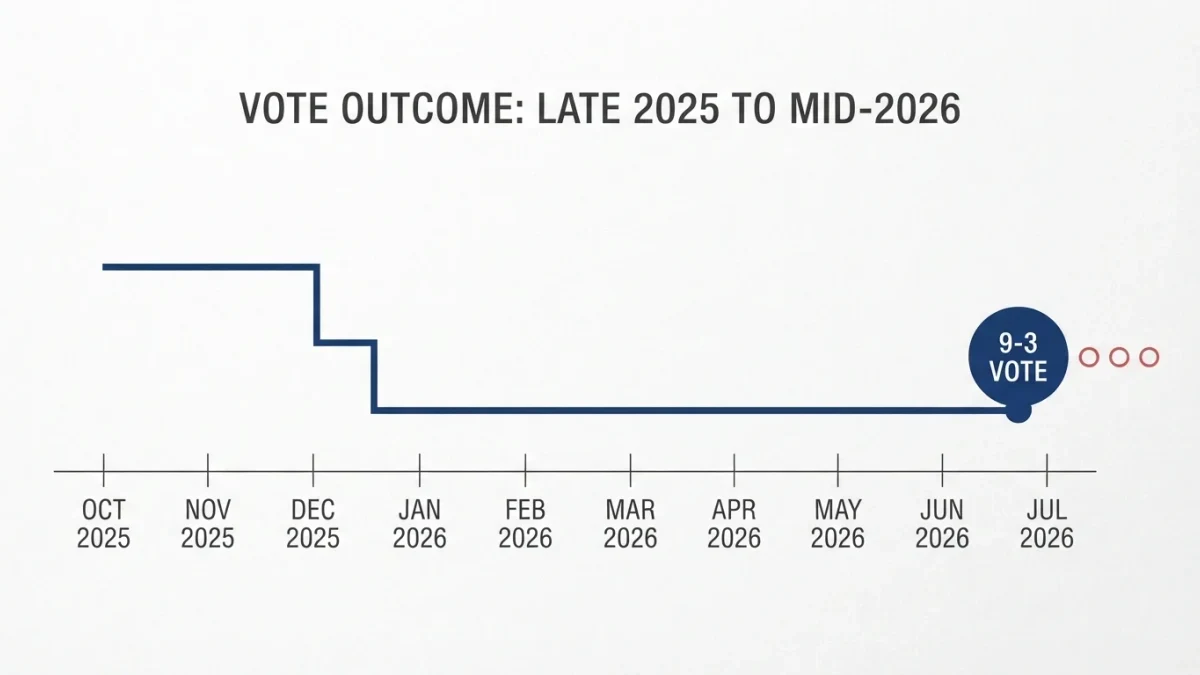
High, on the flat tail of the cycle. The Fed's late-2025 cuts brought the target range to 3.50%–3.75%, and the committee held it there through mid-2026 — so prime sat still at 6.75% and card APRs with it, in the low-to-mid 20s for typical accounts. The pause cuts both ways: savers kept roughly 4% yields at top accounts, and revolvers got a stable, still-expensive card rate. Stability is useful for planning, though — a fixed enemy is easier to amortize than a moving one.
FAQ
Will card APRs ever fall to the 15% range?
Only for individual borrowers who change their pricing — through credit-union cards, strong-credit offers, or negotiated reductions. The market-wide margin has stayed wide through every rate cycle of the past two decades; no plausible Fed path closes it for existing accounts.
Does paying in full make APR irrelevant?
Yes — grace periods mean cardholders who pay the statement balance each month never accrue interest, whatever the contract rate. For them, the rewards-and-fees structure matters more than the APR line they will never touch.
Are 0% balance-transfer offers too good to be true?
The math is real — the cost is the 3%-5% upfront fee and the deadline. A $4,000 balance transferred at 4% costs $160 once versus about $80 a month at 24% interest; the offer fails only the borrower who still owes when the intro clock expires, snapping the balance to the full rate.