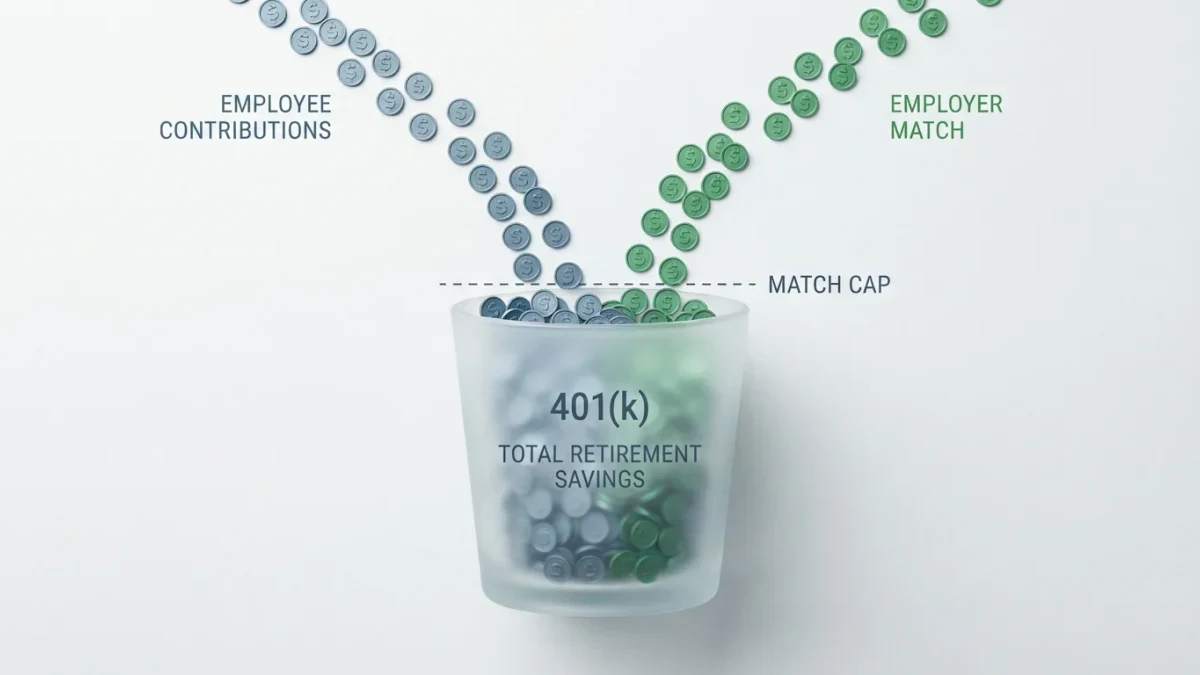
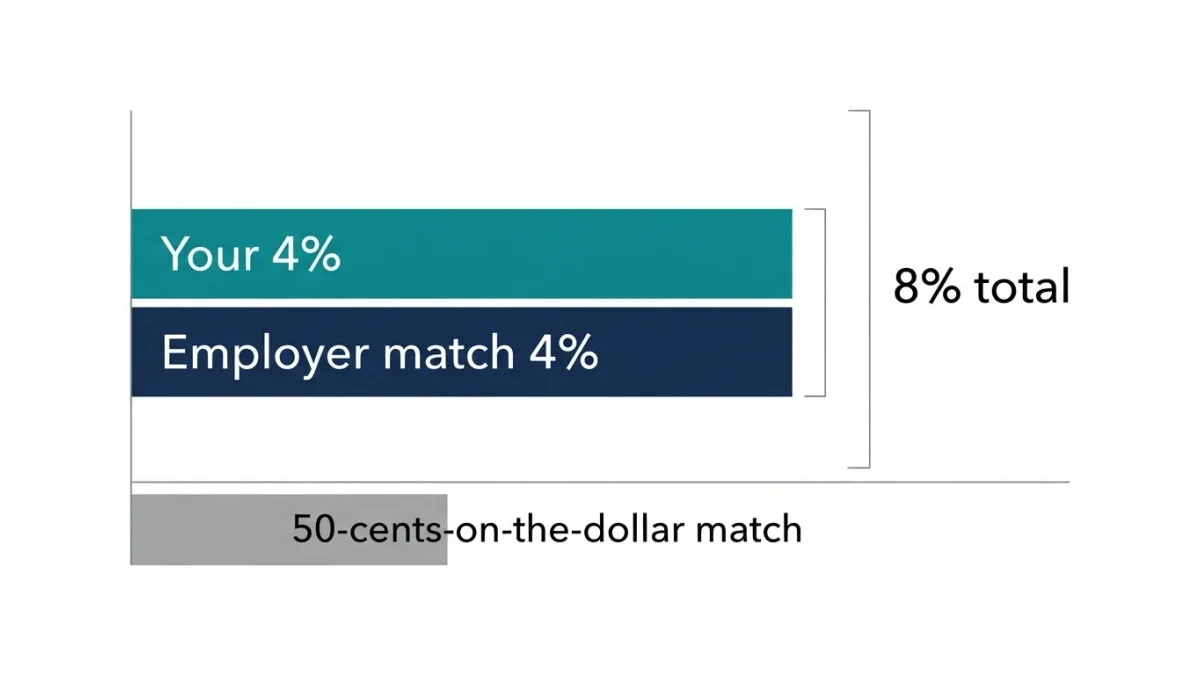
An employer match is your company putting its money into your 401(k) alongside yours, commonly 50 cents or a full dollar for every dollar you contribute, up to a ceiling set as a percentage of salary. Contribute at or above the match threshold and a 100%-of-first-4% formula on a $60,000 salary means your $2,400 of deferrals arrives with another $2,400 of employer money attached — a guaranteed, immediate 100% return before any market movement. The 2026 deferral limit is $24,500, but the match threshold matters more than the ceiling: below it, you decline part of your own compensation.
SAMCASH publishes information, not financial advice — plan rules vary by employer, and your summary plan description is the authority on your formula.
How do the common formulas work?
Three structures cover most plans. Dollar-for-dollar on the first 3–5% of pay: every matched dollar doubles. Fifty percent on the first 6%: each dollar earns fifty cents, so a $3,600 deferral (6% of $60,000) draws $1,800. Tiered matches — full match on the first 3%, half on the next 2% — blend the two. The trap in every formula is the cliff inside it: under dollar-for-dollar on 4%, contributing only 3% captures $1,800 instead of $2,400 — a $600-a-year raise declined — and the gap compounds for a career.
| Formula on $60,000 salary | You contribute | Employer adds | Free money missed at half the threshold |
|---|---|---|---|
| 100% of first 4% | $2,400 | $2,400 | $1,200 at 2% |
| 50% of first 6% | $3,600 | $1,800 | $900 at 3% |
| 100% of 3%, 50% of next 2% | $3,000 | $2,100 | $1,050 at 1.5% |
Illustrative formulas — your plan's exact match is in the summary plan description or your benefits portal.
What does a match become over a career?
Run the arithmetic with stated assumptions. Deferring $2,400 a year with an equal match puts $4,800 a year to work; at an assumed 6% average annual return over 25 years that compounds to roughly $263,000 — versus about $132,000 from your deferrals alone, since 4,800 × [(1.06²⁵ − 1) ÷ 0.06] ≈ 263,350. The employer's money literally doubles the ending balance, and no investment skill was required. Returns are not guaranteed; the match's first-day 100% is.
What is vesting, and why does it matter?
Vesting is ownership. Your own deferrals are always yours immediately; the match typically becomes yours on a schedule — immediately, after a cliff (often three years), or gradually year by year under graded schedules. Leaving before the cliff forfeits some or all employer money, which changes job-switch arithmetic for early-career workers: a $5,000 unvested match is real compensation timing. Ask HR for your balance's vested portion before resigning, and weigh a start date against a cliff anniversary when the dates are close.
How do you make sure you capture all of it?
- Find your formula — benefits portal or summary plan description — and compute the deferral percentage that maxes it.
- Set your deferral at or above that percentage, then use automatic annual escalation to keep climbing toward 15% of pay.
- Check the true-up: plans without year-end true-up matches per paycheck, so a mid-year raise or an early contribution halt can leave match dollars unclaimed — front-loading contributions in January sometimes backfires in those plans.
- Confirm after every raise that your percentage still clears the threshold — dollar-amount elections silently fall behind salary growth.
Does the match count against the $24,500 limit?
No. Your elective deferrals alone count toward $24,500 in 2026; employer matching belongs to the separate $72,000 combined limit. A full match can sit on top of a maxed deferral, which is how dedicated savers reach five-figure annual totals. One nuance for the highly paid: match dollars are always pre-tax today unless your plan has adopted Roth match treatment — an emerging option — so the taxation of employer money defaults to traditional even when your own deferral is Roth.
FAQ
Is the match really free money?
It is deferred compensation you already earned — part of your total pay package that requires only an election to claim. Skipping it is not avoiding risk; it is declining salary, which is why every priority list puts the full match ahead of nearly everything except basic survival.
What if I cannot afford to contribute enough to max the match?
Move up one point at a time — from 3% to 4%, then 5% — ideally timed with raises so take-home never falls. Even partial capture beats none, and escalation closes the gap within a couple of review cycles.
Can I get the match if my employer offers a Roth 401(k)?
Yes — the match attaches to your deferrals regardless of which tax treatment you elect, and employer dollars are traditionally pre-tax unless the plan specifically adopted Roth matching. The investing mechanics are identical.