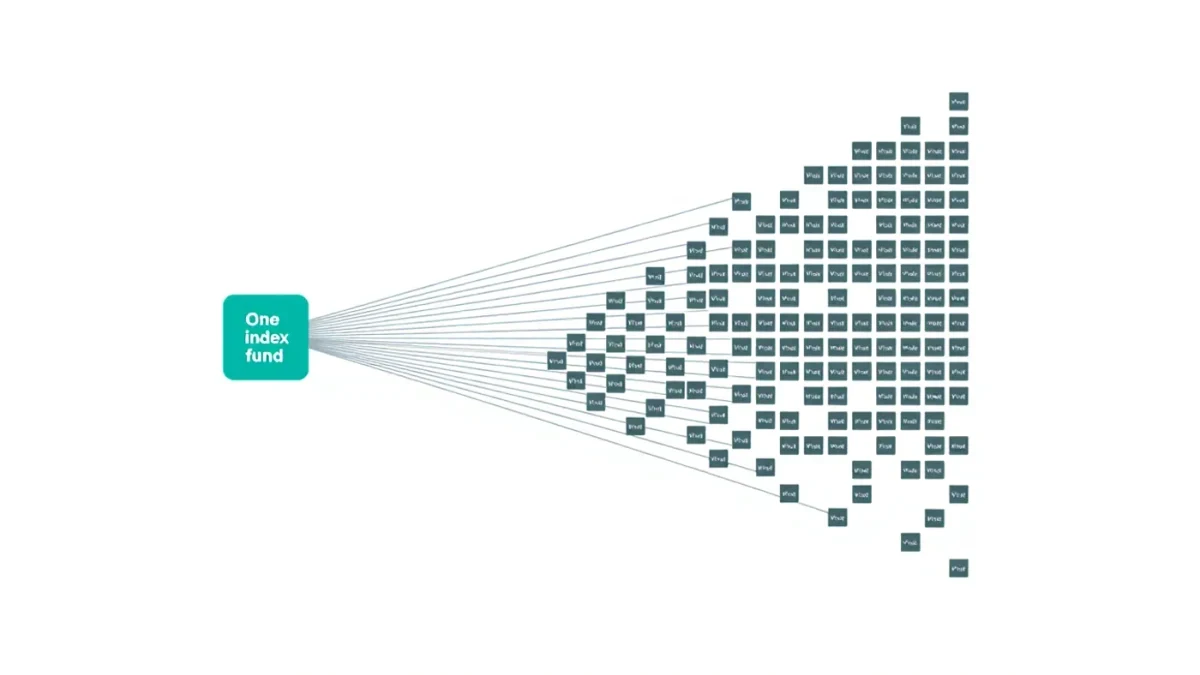

For most households, index funds are the more sensible default, and individual stocks are the optional extra. An index fund owns a whole slice of the market in one purchase, so no single company can sink you. Picking your own stocks can work, but it demands more time, more discipline, and a stomach for swings that most people honestly don't have.
The most important qualification: this is not either-or. Many investors hold index funds as a core and buy a few individual stocks on the side, with money they can afford to see fall. The right mix depends on how much time you want to spend, how you react to losses, and which account you invest through.
What is the actual difference between an index fund and a stock?
A share of stock makes you a part-owner of one company. Its price rises and falls with that company's fortunes, its industry, and investor mood. An index fund pools money from many investors and buys a basket of securities designed to track a market yardstick. The word itself is broad — as Wikipedia notes in its entry on the term, an "index fund" is a collective investment scheme, one of many meanings of the word index — but in practice it means one purchase that spreads your money across many companies at once.
That single structural difference drives almost everything else in this comparison. One bet versus hundreds of bets. One company's earnings report versus the whole market's average direction. One fee negotiation versus one built-in expense ratio — the yearly cost a fund charges, shown as a percentage of your money.
How does diversification change the risk?
With an index fund, a single company can disappoint you and barely dent your balance. With individual stocks, one bad quarter, one scandal, or one bankruptcy can erase years of gains. That's the whole argument for diversification, and it isn't a subtle point — it's the difference between a portfolio that survives a bad year and one that doesn't.
Index funds also diversify for you automatically. You don't have to research twenty companies, size twenty positions, or rebalance twenty holdings. The basket does the spreading. If you buy individual stocks, the diversifying work is yours, and skipping it is how people end up concentrated in one sector they know well and one crash they didn't see coming.
What does it cost in time and fees?
Index funds are close to a zero-effort holding. You buy, you set up automatic contributions, you check in a few times a year. The main cost is the expense ratio, and broad index funds tend to charge far less than actively managed funds because there's no analyst team to pay. It's worth reading what a fund's expense ratio is and how to find yours before you buy, because small percentages compound into real money over decades.
Individual stocks cost you time, which is a real cost even though no statement shows it. You need to read earnings, follow news about your holdings, and decide when to sell — which is harder than deciding when to buy. Trading can also carry commissions or spreads depending on your brokerage, and frequent trading racks up costs that a buy-and-hold index investor simply never faces. Readers following this should also see How a 401(k) employer match works — and what it costs to skip it.
How do taxes differ?
In a taxable brokerage account, the tax treatment differs in a way that quietly favors patient investors of either kind. Sell a stock or fund you've held more than a year and you generally owe long-term capital gains rates, which are lower than the rates on short-term gains. Sell quickly and the gain is taxed as ordinary income at higher rates.
Here individual stocks create a temptation index funds don't: the quick trade. Each trade is a potential tax bill, and every rebalancing decision becomes a tax decision. Index funds, held patiently, generate fewer taxable events on their own — though some funds distribute gains you'll still owe tax on. Inside retirement accounts like a 401(k) or an IRA, this whole issue mostly disappears, which is one reason those accounts are the natural first stop. Our analysis: the tax angle rarely decides the index-funds-vs-stocks question on its own, but it adds friction to stock trading that people underestimate.
Which fits your temperament?
This is the factor people skip, and it's the one that breaks most stock-picking plans. When a stock you own drops 40% in a bad stretch, do you hold, buy more, or panic-sell at the bottom? Your honest answer matters more than your research skill. It's worth working through risk tolerance before choosing between the two approaches, because the best strategy on paper fails if you can't live with its swings. This connects to our earlier piece, Risk tolerance investing — Risk tolerance: how to figure out yours honestly.
Index funds blunt that problem in two ways. The swings are smaller because you're diversified, and there's no single company story to obsess over. That said, index funds still fall — sometimes sharply, all at once. Nobody holding a total-market fund was spared the downturns. The difference is that a diversified holder has no single company to blame, which makes it easier to sit still.
What this means for your money: a practical way to choose
If you want a decision process rather than a verdict, work through these steps:
- Start with the accounts that come first anyway. An employer match in a 401(k) is the best deal in investing — see how a 401(k) employer match works before you think about anything else.
- Make index funds your core. If you're starting out, a broad index fund inside a tax-advantaged account is the plainest path. Our guide to what an index fund is and why beginners start there covers the mechanics.
- Add individual stocks only as a satellite. If you enjoy the work and want to learn, a small slice of your portfolio in companies you've genuinely researched is a reasonable hobby with a tuition cost. Keep the core intact.
- Automate either way. Regular contributions through ups and downs — the approach behind dollar-cost averaging — removes the temptation to time the market, which is where most self-directed investors lose money.
One honest caveat on outcomes: neither approach promises a return. Index funds will match their market, up and down. Individual stocks can beat that market or badly trail it, and the research consensus is that most stock pickers trail the market over long periods — though the size of that gap varies by study and period, and we won't put a number on it without a source in front of us.
The bottom line on index funds vs. stocks
The evidence points one way for most people: index funds win on diversification, effort, and cost, and they remove the two biggest investor failure points — concentration and panic. Individual stocks are a legitimate choice for investors who have the time, the temperament, and the willingness to be wrong in public. There's no shame in choosing the boring option; boring is what compounding is built on.
What remains unknown is your own answer to the temperament question, and no article can supply that. If you're unsure, the satellite approach lets you test stock-picking with limited downside while your core keeps doing its quiet work.