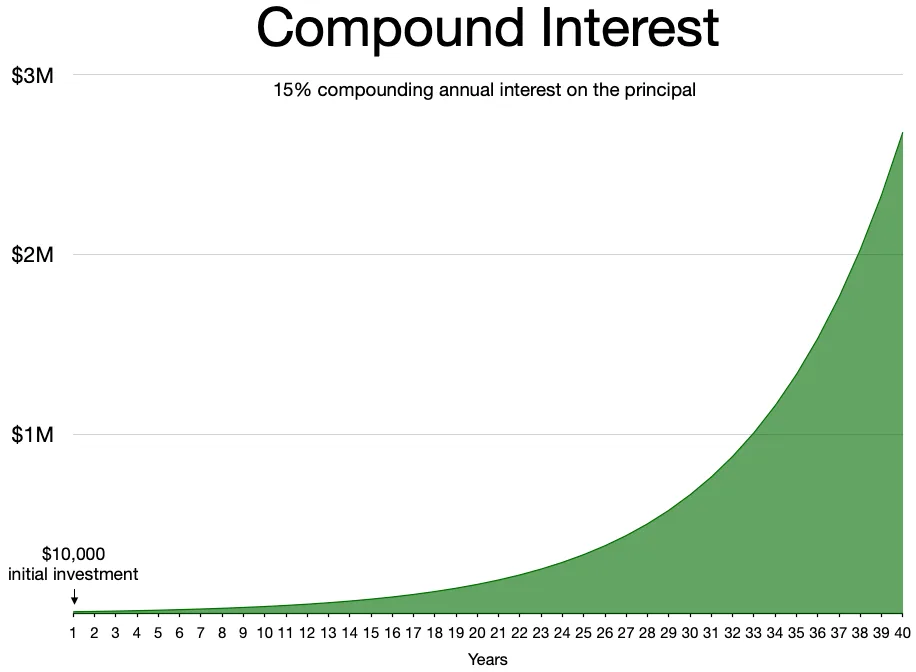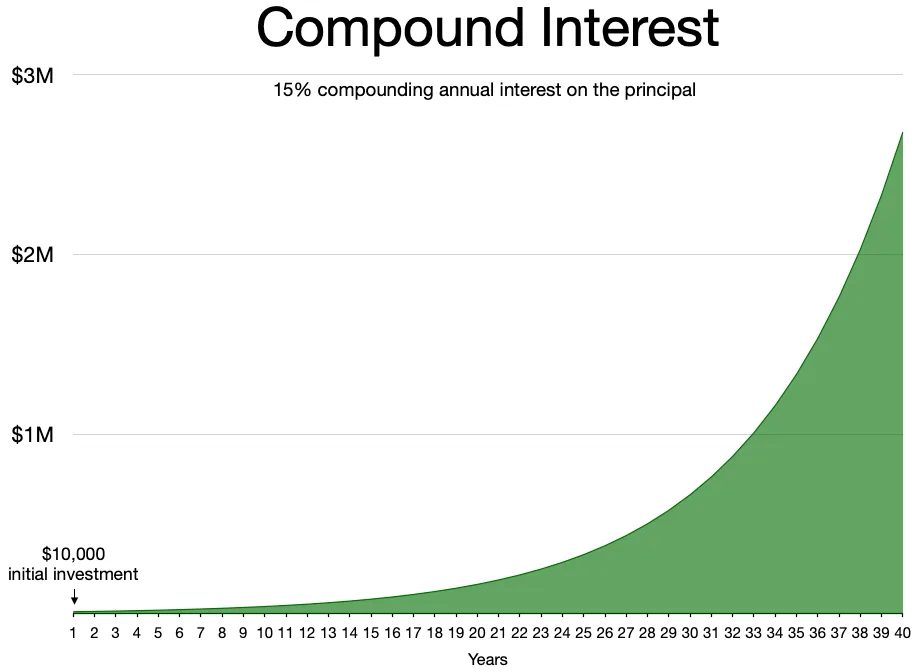

Compound interest is interest calculated on both your original deposit and on the interest that deposit has already earned. Each cycle, the interest payment gets a little bigger, because the base it is calculated on keeps growing. That is the whole mechanism — and it matters more than almost anything else about when you enter the market.
The practical takeaway is simple: time in the market does more work than picking the perfect entry point. A modest deposit left alone for years can outgrow a larger deposit that starts later, because the early money has more compounding cycles behind it. The figures below, drawn from a published compound interest calculator, show exactly how that plays out.
What is compound interest, exactly?
Compound interest means accumulated interest is added back onto the principal, so future interest is calculated on both the original sum and the interest already earned. Simple interest, by contrast, is calculated only on the principal, so each year's payment stays the same size.
According to The Calculator Site, a $1,000 deposit at a 5% yearly rate compounded annually earns $50 in year one, $52.50 in year two, and $55.13 in year three — each year's interest higher than the last, with the balance reaching $1,276.28 after five years and $1,628.89 after ten years. The growth looks unremarkable at first. It is the shape of the curve, not the size of any single payment, that does the work.
How does compounding change a real balance?
Here is a worked example, with every assumption stated. Suppose you deposit $5,000 at a 5% yearly rate, compounded monthly, and leave it for five years. The Calculator Site's calculator puts the ending balance at $6,416.79, of which $1,416.79 is interest earned. The effective annual rate — the APY, meaning the yearly rate you actually receive once compounding is included — works out to 5.12%, slightly above the 5% nominal rate.
Two details in that example are worth noticing. First, the interest grows every month: the calculator's monthly breakdown starts at $20.83 in month one and reaches $26.63 by month sixty, because each month's interest is computed on a slightly larger balance. Second, the same calculator estimates that money at 5% takes roughly 13 years and 11 months to double. Doubling is slow at first and then, by the nature of the math, each doubling takes about as long as the last — which is why the final years of a long investment contribute the biggest jumps.
Why starting earlier beats picking a better moment
The brief behind this piece asked for charts showing how starting earlier changes outcomes more than picking winners. The mechanism is visible even in a single-deposit example. Interest in year one of the $1,000 example is $50. Interest in year ten is $77.57 — a payment more than half again as large, earned by the same original deposit, purely because it had nine more years of accumulated interest underneath it.
Now imagine two savers. One deposits early and lets compounding run. The other waits, hoping to buy in at a better price, and loses those early cycles. The waiting saver may well pick a better entry price. But the early saver's money has already started compounding, and every cycle the waiter skips is a cycle that never gets replaced. Waiting for the perfect moment is a bet that your timing skill will outrun the compounding you gave up — and the compounding side of that trade does not depend on skill at all.
Our analysis: for most household investors, the controllable variables are when you start, how much you add regularly, and what you pay in fees. Entry timing is the least controllable of the three, and the evidence above suggests it is also the least rewarded.
What this means for how you invest
Compounding rewards three habits, and none of them require forecasting markets.
- Start early, even small. The Calculator Site's guidance is blunt: start investing early, because smaller amounts given more time can beat larger amounts given less. If you are unsure where to begin, our guide to how to start investing with $100 walks through the first steps.
- Contribute regularly. Each new contribution starts earning its own interest, which amplifies the effect. Setting up automatic contributions is one way to make regularity automatic rather than a monthly decision — the approach behind dollar-cost averaging.
- Watch what comes out. Fees are deducted from the balance that compounding is working on, so every dollar of cost compounds against you. Before choosing a fund, it helps to understand what a fund's expense ratio is and how to find yours.
Where the money sits matters too. Tax-advantaged accounts such as a Roth IRA or a workplace 401(k) let compounding happen without some of the tax drag, and an employer match adds to the principal that compounds — which is why skipping one is expensive in a way the compound math makes obvious. For the account-level trade-offs, our comparison of 401(k), IRA, and Roth accounts covers the differences. We covered a connected angle in How a 401(k) employer match works — and what it costs to skip it. We covered a connected angle in How a 401(k) employer match works — and what it costs to skip it.
What compounding cannot do
Compound interest describes a mechanism, not a promise. The examples above use fixed rates; real investments do not have fixed rates, and their value can fall as well as rise. Compounding amplifies whatever the underlying return is, including losses. That is why the same patience that makes compounding work also argues for not betting on one stock, and for being honest about your risk tolerance before choosing where the money goes.
It also works against you in reverse. Credit card balances and other revolving debt compound too — the interest is added to what you owe, and future interest is charged on that larger amount. If you are weighing growing investments against shrinking a balance, our guide on whether to invest or pay off debt first lays out how to think about it.
The takeaway
Compound interest is interest earned on principal plus previously earned interest, and its power comes from cycles, not cleverness. The published calculator figures make the point concretely: $5,000 at 5% compounded monthly becomes $6,416.79 in five years, and a $1,000 deposit at 5% takes roughly 13 years and 11 months to double. The earlier the cycles start, the more of them you get, and no entry-timing decision can manufacture the ones you skipped. Start when you can, add regularly, keep costs low, and let the arithmetic do the part of the work that does not require being right about the market.